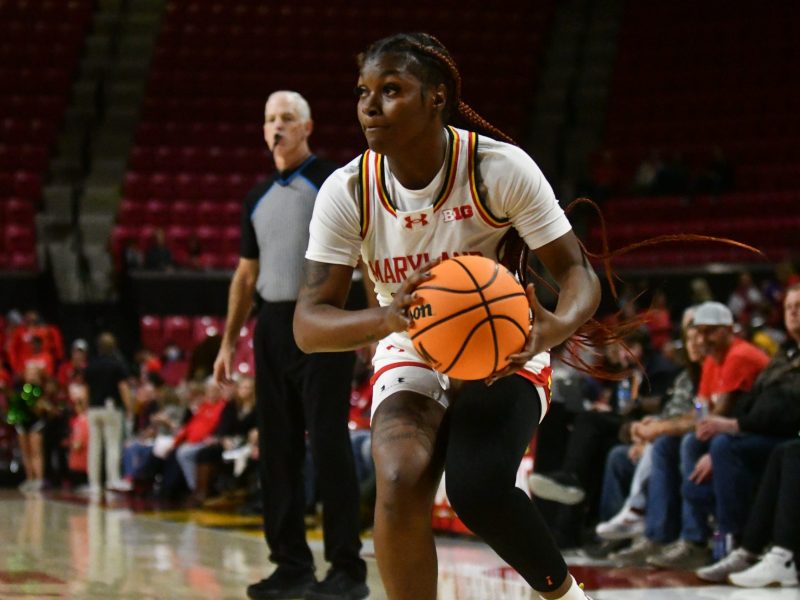
Elijah Saunders admitted he had a rough November.
The Virginia transfer logged double-digit points in just three of Maryland men’s basketball’s first 11 games. Saunders attributed the struggles to “inconsistency with the lineups” as the Terps dealt with a slew of injuries, but acknowledged that wasn’t an excuse.
“No one’s coming to save you,” he said, adding he expected his play to stabilize as the rotations did.
Saunders put together a strong outing Saturday in his return to Charlottesville despite hearing boos when he touched the ball, scoring 10 second-half points on 4-for-5 shooting. But the efficient effort wasn’t enough to overcome a key absence in Maryland’s 80-72 loss to No. 23 Virginia.
Without injured forward Pharrel Payne, the Terps allowed Virginia to score 44 paint points and knock down 21 second-half field goals. The size and talent disparities handed the Terps their fifth straight loss to a Power Four opponent, a familiar sight in their last high-major nonconference game.
Maryland (6-6) trotted out its sixth starting group of the season. Myles Rice, Diggy Coit, Solomon Washington, George Turkson and Saunders hadn’t all played a single minute together prior to Saturday.
[Buzz Williams preaches process over results amid Maryland men’s basketball’s rough stretch]
Saunders joined Coit (15 points) and Rice (12 points) as the only Terps to reach double figures.
Although the starting group likely practiced together throughout the week, the lack of in-game experience was apparent early.
Virginia (10-1) scored seven unanswered points before the first media timeout. The Cavaliers grabbed the game’s first six offensive rebounds — the result of a shorthanded Maryland frontcourt missing senior forward Pharrel Payne. Coach Buzz Williams relied on a center-by-committee approach with Saunders, Turkson and Washington.
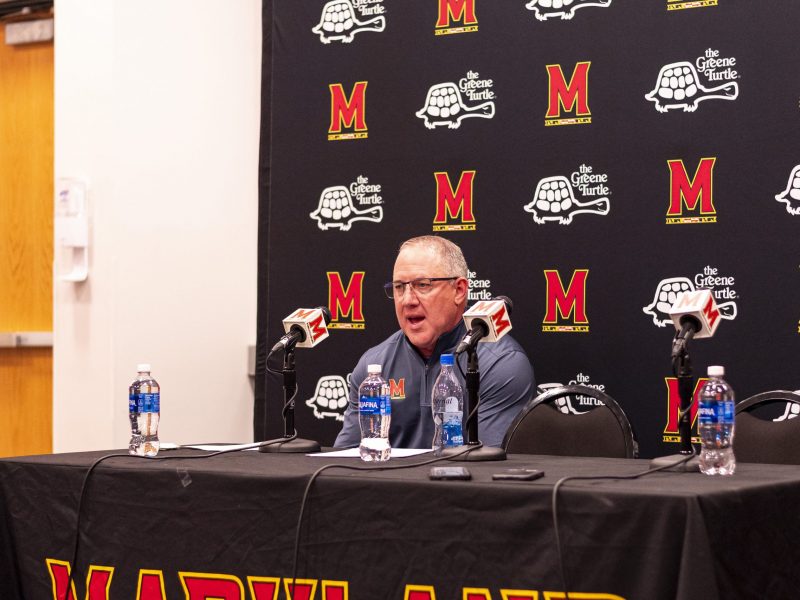
“We’ve got to continue to increase the execution, coupled with that — continue to find ways for our endurance of that execution to increase,” Williams said.
After the early struggles came a momentary surge.
Maryland held the Cavaliers scoreless for nearly six minutes, their longest drought of the season, midway through the first half. The second-highest scoring Virginia team in program history missed 10 straight field goals and committed 11 first-half fouls.
More than 27 percent of the Terps’ points this season have come off free throws — the most among Power Four teams. Maryland’s foul-hunting ability was rewarded when it got into the double-bonus, helping extend its lead to as many as eight points amid a 9-0 run.
The Terps’ fleeting success was anchored by Solomon Washington. The senior forward logged a game-high 12 rebounds in 36 minutes, eight of which came on the offensive glass, and he held Virginia leading scorer Thijs De Ridder to five points on 1-for-8 shooting.
[Bri McDaniel to redshirt Maryland women’s basketball’s season amid ACL recovery]
“We did a good job offensive rebounding,” Williams said. “We’ve had some growth. Not necessarily can all of it be seen on the scoreboard.”
But Washington shot just 2-for-8 himself — part of an inefficient offensive output for Maryland.
Williams’ group shot 5-for-24 in the first 20 minutes Saturday. Virginia, after falling behind 19-11, jetted to a 13-0 run before halftime, then scored eight unanswered points in a decisive early-second half stretch.
Williams briefly shifted to a zone after halftime. Similar to Maryland’s man defense, weak perimeter pressure left gaping holes in the wings and corners.
The Cavaliers knocked down six second-half 3-pointers after converting just one in the first period. Dallin Hall and Jacari White combined for 35 points, 30 of which came in the final frame.
Williams tabbed Maryland’s high turnover rate as its biggest offensive problem last Saturday. The Terps’ 13.7 turnover average was a Big Ten high, and its abysmal 0.81 assist-to-turnover ratio was a conference low.
Saturday served as another glaring example.
The Terps committed 10 first-half turnovers, which doubled their five made field goals before the break. Maryland’s turnover count ballooned to an eventual 19 — a majority of which came on live-ball sequences.
The Cavaliers scored 22 points off those giveaways, a massive swing in an eventual eight-point loss.
“Some of the things that have plagued us all year long seem to be some of the mountains that we couldn’t overcome,” Williams said. “We’re going to keep finding ways, marginally, to find solutions to our problems.”