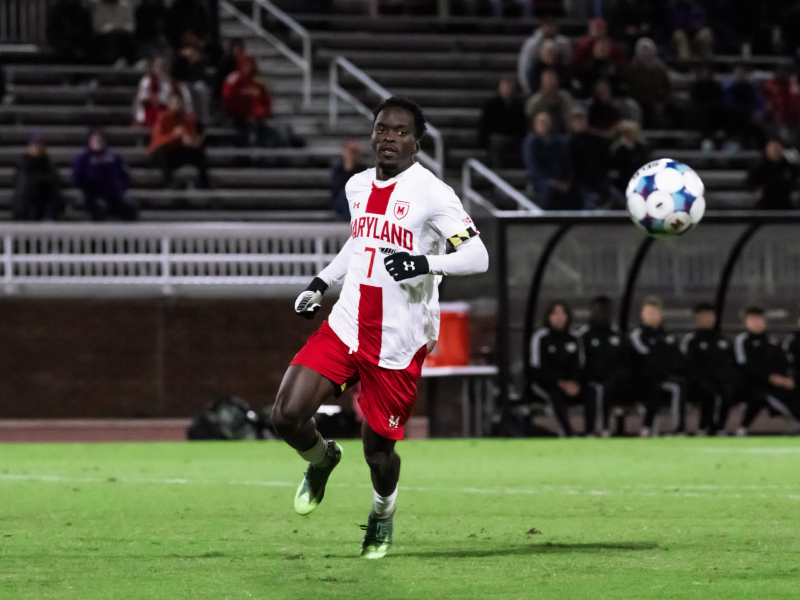
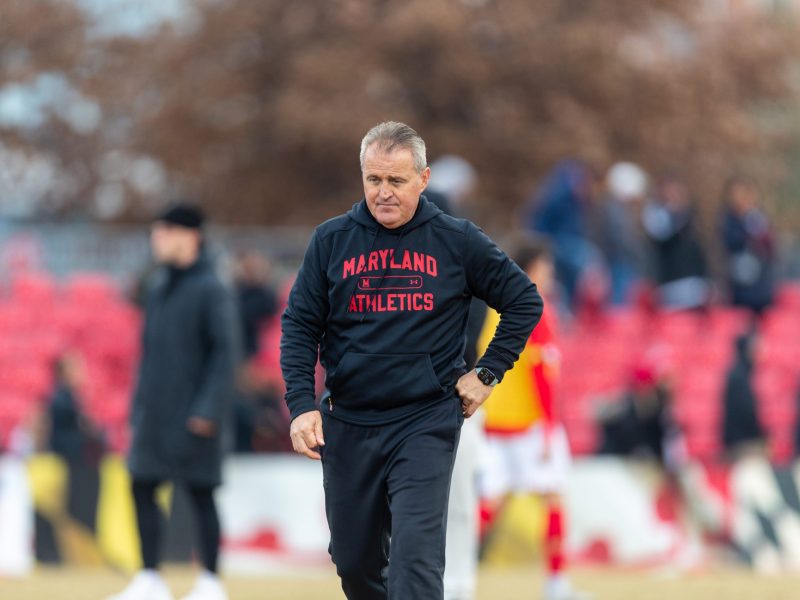
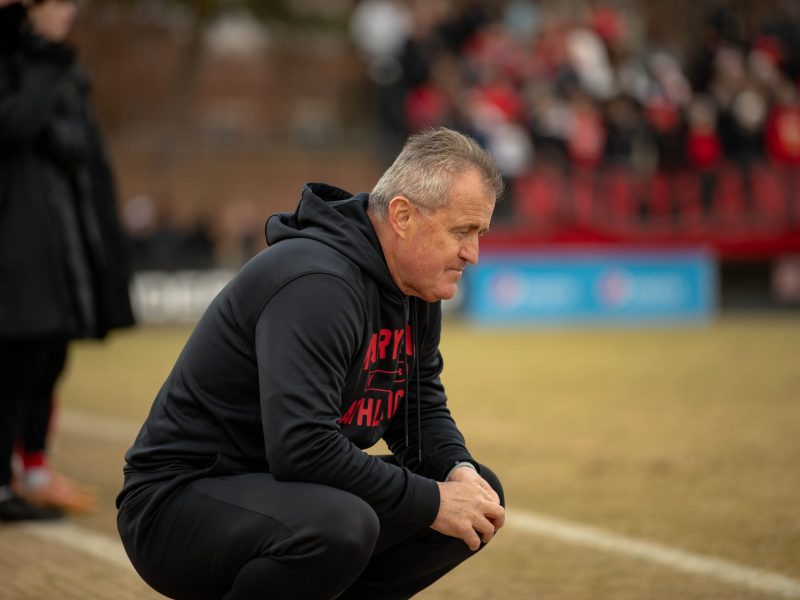
Joseph Umberto Picotto entered his fourth college campus in as many years when he transferred from UMBC to Maryland men’s soccer.
And despite the movement, transferring never became easier for the senior. The Pinerolo, Italy, native described the process as “a heavy burden on the human mind.” The start to Umberto Picotto’s fall semester in College Park was particularly tumultuous.
He woke up the morning of Maryland’s match against Saint Francis — the eve of the University of Maryland’s first day of classes — feeling awful. A doctor’s visit revealed he needed to get his appendix removed immediately.
With an ocean between him and his relatives, Umberto Picotto turned to his only semblance of family in the United States: the team.
A pair of staffers transported Picotto to and from the hospital. Roommates Henry Bernstein and Luke Burdett supported him throughout his recovery, as did their families. It helped the Italian midfielder return to game action by late September.
Picotto’s story is a microcosm of the international athlete experience. The stress of balancing athletics and academics is only worsened by the adjustment to a new culture, but players feel the relationships they developed make the struggle worthwhile.
“It’s why many internationals love college,” Umberto Picotto said. “You find yourself in a mixed pot of cultures that you can probably not find anywhere else.”
Most of the Terps’ 13 international players come from countries where English isn’t the primary language, and they were required to take a proficiency test before starting at this university.

Those who don’t meet the scoring threshold must enroll in the English Bridge Program. Danish senior Luca Costabile experienced it as a freshman.
As grueling as it may be, the program helps international students. But picking up on regional dialects and slang is a separate struggle, which Umberto Picotto realized at UMBC.
“For like a month, me and the dining hall people could simply not communicate,” he said. “Especially with this strong accent, and them having a strong accent as well.”
[Rocket Ritarita sends Maryland men’s soccer to NCAA tourney quarterfinals in 3-0 win over UConn]
Adjusting to daily life is also challenging. Cultural differences are found in the most subtle ways.
Umberto Picotto has lived in the U.S. for more than three years, but thinks it’s odd that American restaurants serve beverages with ice, which hurts his gums. He’s used to the Italian custom of serving drinks chilled.
German midfielder Leon Koehl has a simpler liquid-related gripe.
“I had to get used to the water here,” he said. “The water doesn’t taste as good as home.”
Water aside, Koehl’s transition to life in the states was relatively smooth.
He tested out of the English Bridge Program and joined a 2023 Terps squad that included a pair of German upperclassmen in Bjarne Thiesen and Alex Nitzl — the latter being the reason Koehl came to Maryland.
“It’s different when you have someone in your own mother language who you can talk to, and who makes you feel at home a bit,” Koehl said.
Koehl’s arrival marked the start of Maryland’s German pipeline. Coach Sasho Cirovski’s current roster features five Germans.
Recruiting overseas prospects can be a trying process, but current players serve as ambassadors. It’s one of the reasons why Maryland landed German right back Farouk Cisse, whose friendship with Koehl dates back to childhood.
“I remember calling Sasho when he was on his hiking trip in Croatia,” Koehl said. “He was breathing heavily, and I just was telling him about this player that I could have for us, and he immediately seemed interested. He called me nearly every two or three hours.”
Costabile, a Copenhagen native, said Norwegian defender and former teammate William Kulvik was the first Maryland soccer player he interacted with. The Scandinavians bonded over their cultural similarities.
[How Buzz Williams turned a ballroom into Maryland men’s basketball’s Las Vegas headquarters]
Now a senior, Costabile has gone from mentee to mentor through his brotherly bond with Danish freshman Emil Nymann Anderson.
“We went to do all the paperwork together — like meetings, bank meetings, all of these different things you got to do when you come to the U.S.,” Costabile said. “I did everything with him because I knew how it was. I’ve been through it myself.”
The international Terps also use food as a cultural bridge.
Umberto Picotto said he and Costabile — who’s half Italian — try to cook a meal together once a week, even if the ingredients aren’t as fresh in the U.S.
But equally, Costabile and Koehl are fond of an American staple that neither can get back home: Chipotle.
“There’s so many smaller chains here that are so, so, so good, and if you brought that to Europe, it would have so much success,” Costabile said. “My parents come over here and they’re like, ‘We should bring this to Denmark, we should bring Chipotle to Denmark.’”
Many of the international players are well-traveled within the United States — Umberto Picotto said he’s been to more than 40 states, and Koehl called New York City one of the most unique places he’s been.
“Walking around, I felt like I was in Spider-Man,” he said.
Several have also taken an interest in American sports.
Umberto Picotto said he started following basketball. Koehl and Costabile became Ravens fans, despite possessing minimal previous American football knowledge. The pair also expressed appreciation for the relaxed environment of American bars, an uncommon characteristic of European nightclubs.
Those relatively trivial pleasures help Maryland’s international players feel comfortable in an unfamiliar setting. But the people make College Park feel like a second home.
“People are just so genuine here and it’s just amazing to be here,” Costabile said. “I’m so sad it’s almost over, but that’s the name of the game.”