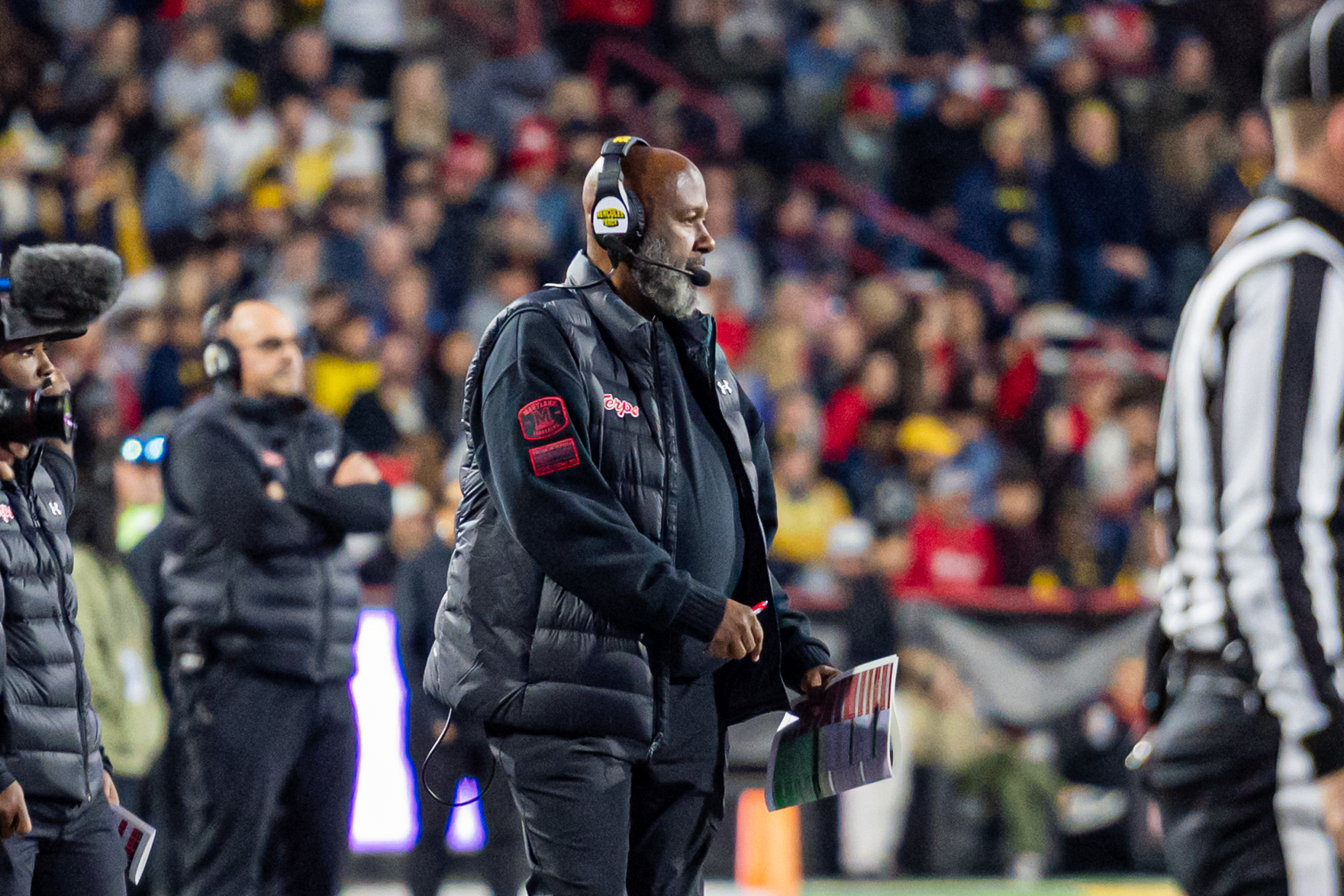
In July, coach Michael Locksley said this season would be a year of “elevation” for Maryland football.
He said the foundation he built over his six seasons in College Park would allow the Terps to quickly rebound from a 4-8 campaign. But his outlook wasn’t remotely accurate.
Maryland finished with the same record, lost by double digits in each of its last five games and ended on an eight-game losing streak in its worst skid since 2015. While first-year athletic director Jim Smith announced that Locksley will return next season, plenty of questions linger about the Terps’ future.
“This has been a tough two-year stretch,” Locksley said Saturday after the loss to Michigan State. “We did not meet expectations … not coached good enough, not played well enough. That starts with me and it’s my job to quality control this season.”
Maryland’s two conference wins the past two years rank second-worst in the Big Ten, only above Purdue, which went winless in conference play.
Yet Locksley repeated throughout the season that Maryland is no longer a developmental program and is focused on winning now as college athletes are paid and expectations heighten. But before the Terps faced Rutgers on Nov. 8, he said a second Big Ten win would signify progress because it meant one more conference victory than last season.
Maryland couldn’t reach that low bar — despite playing a Rutgers team that gained only one other Big Ten win against Purdue, and a Michigan State squad that entered the regular season’s finale winless in conference play.
[Maryland football’s season ends in 38-28 loss to Michigan State]
While Locksley admitted his team failed to meet expectations, he did find a promising prospect at the game’s most important position.
Quarterback Malik Washington threw for 459 yards against the Spartans, the second-most in a game in program history. The Glen Burnie native notched 2,963 passing yards, 17 touchdowns and nine interceptions on a Big Ten-high 473 attempts. He also led the Terps with four rushing scores in an encouraging freshman campaign.
“We’re taking steps in the right direction, now we just have to continue,” Washington said. “We all want to play for coach … we know our coach has our back.”
Locksley acknowledged Maryland won’t be able to return all its impactful players and must “keep the right ones,” likely starting with Washington. Retaining freshman defensive linemen Zahir Mathis and Sidney Stewart — each of whom recorded at least four more sacks than any other Terp — is also key, with five-star edge rusher Zion Elee set to join them next year.
Many additions must be made to bolster a roster Locksley admitted lacked depth, especially considering the increased financial support Smith pledged.
Maryland loses senior receivers Shaleak Knotts, Octavian Smith Jr. and Jalil Farooq. While each collected more than 100 receiving yards just one time in Big Ten play, they led the team in that stat. Redshirt sophomore Dorian Fleming is likely to return, despite dropping six passes, tied for the lead nationally among tight ends.
“This isn’t the same old Maryland,” Smith Jr. said. “These young guys that we have here, they’re going to do great things for this program.”
Locksley said the Terps can build off staying together this season, after he admitted to losing the locker room in 2024. Smith Jr. said one of the coach’s changes was making players sit with a different group of teammates everyday and share vulnerable stories, building closeness and often inciting tears.
[Maryland football’s rushing woes are both offensive and defensive]
Locksley pointed to penalties and turnovers as other areas of progress. Maryland averaged 6.4 penalties a game in 2024 and six this year, still second worst in the Big Ten. The Terps led the conference with 19 interceptions and four defensive touchdowns.
But Maryland surrendered at least 390 yards in every Big Ten game outside of its win against Wisconsin.
The defense allowed 39.4 points a game in five November contests — the month Locksley boasts the worst winning percentage of any Big Ten coach since he took over in 2019. An offense last in the conference in time of possession rarely alleviated pressure.
Locksley said establishing the run was a point of emphasis entering this season. He didn’t give a concrete reason as to why that wasn’t successful.
The Terps averaged the second-fewest rushing yards in the Big Ten, despite starting the same offensive line every game.
Redshirt freshman running back DeJuan Williams averaged less than four yards a carry, though he ranked atop Big Ten running backs with 426 receiving yards.
“We got some young players’ valuable experience that will lay a foundation that I think we’ll be able to build upon,” Locksley said. “But the end results are we didn’t win enough games.”
Locksley stood at Big Ten football media day just more than two years ago and proclaimed Maryland was ready to compete for conference championships. While that didn’t happen, he led the Terps to a third-straight bowl game win the ensuing season — a first in program history.
He enters 2026 looking to avoid a third-consecutive finish at the bottom of the Big Ten. Drastic improvements have to happen to ensure next year is finally one of “elevation.”
Locksley’s time in College Park is probably over if it’s not.
CORRECTION: A previous version of this story misquoted coach Michael Locksley. This story has been updated.