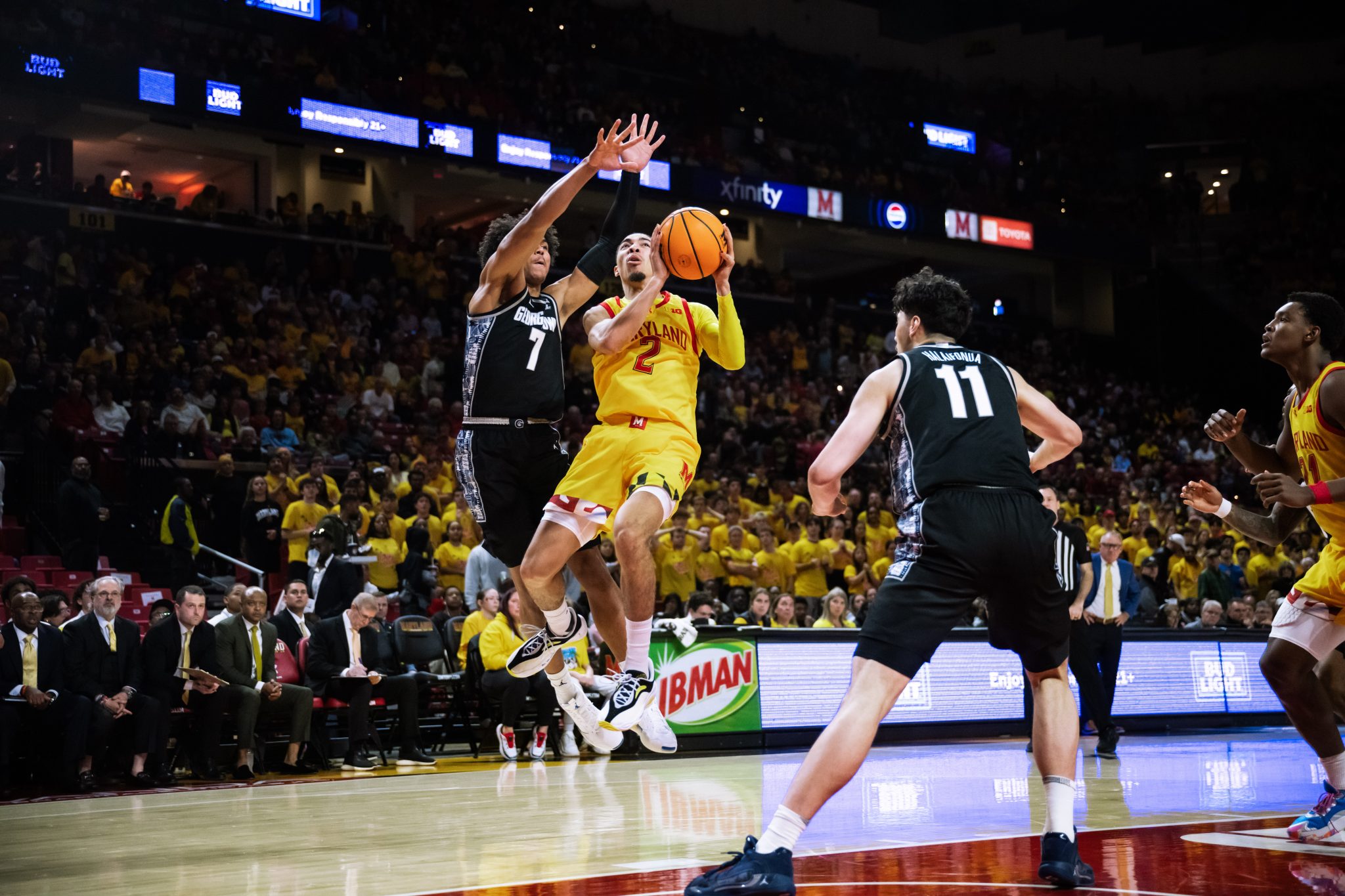
Coach Buzz Williams offered a pointed criticism of redshirt junior guard Myles Rice after Maryland men’s basketball’s loss to Georgetown at the beginning of the season.
“We have a turnover rate problem,” Williams said. “We don’t need him to be [one assist to four turnovers] going the wrong way. We need him to be four and one going the right way.”
Williams referred to the Indiana transfer — who made his Maryland debut that night — as one of the team’s primary ball handlers. He added that Rice’s speed is a crucial component to the offense, and that as he continued to work back from an ankle injury, the Terps would need him to cut down on the turnovers.
Rice didn’t suit up in the Terps’ next three games against Alcorn State, Marquette and Mount St. Mary’s. He returned for the Players Era Festival in Las Vegas last week, producing just nine points and 10 assists in 45 minutes across three games.
The 6-foot-3 guard made only three of his 13 field goals in Las Vegas and is shooting 31.8 percent this season.
When asked about Rice after Maryland’s loss to then-No. 12 Gonzaga, Williams said he needed to find the right combination of players.
“Whether that includes Myles or not, we’re not at the point where we weigh that,” Williams said.
[Maryland men’s basketball outclassed by No. 12 Gonzaga, 100-61]
Rice was expected to be a key cog in Maryland’s offense as one of just two players with prior Big Ten experience. It hasn’t worked out so far. Williams said the guard is “probably getting healthier” — and it’s possible he’ll find a rhythm once he’s fully healed — but for now, Rice’s struggles continue to hinder Maryland’s offense.
Here are some more takeaways from the Terps’ season so far.
A thin frontcourt
Ahead of the season, most people expected Pharrel Payne to be the team’s centerpiece. They were correct. The senior forward leads the team in scoring, rebounding, blocks and field goal percentage despite missing a game with an injury.
But those numbers don’t explain the full extent of Payne’s value. He’s holding up an underwhelming frontcourt, either due to a lack of health or poor performance.
Senior forward and Texas A&M transfer Solomon Washington is yet to play due to an ankle injury he sustained during the offseason. Fellow Aggie transfer and redshirt freshman George Turkson Jr. has been wearing a boot for the past two weeks, and before then, averaged just a point and two rebounds in three games.
Virginia transfer Elijah Saunders’ numbers have dipped from a year ago despite playing more minutes. The senior forward is averaging 8.4 points and 5.1 rebounds while shooting 39.3 percent from the field and 25 from three. Northeastern transfer Collin Metcalf has looked virtually unplayable at times. The senior, who some expected to be Payne’s direct backup, has recorded 13 fouls compared to just one made field goal in seven games.
[Buzz Williams’ sideline energy leads Maryland men’s basketball]
All of those factors have increased Payne’s importance. Williams said the Terps need Payne to play as many minutes as he possibly can. He’s right if they want any chance of matching up against the vast majority of the Big Ten.
Young players flash
Freshman Aleks Alston is one frontcourt player who’s shown promise behind Payne. The former three-star recruit saw his minutes increase in Las Vegas, and for good reason.
He averaged 5.3 points and seven rebounds a game in those three contests. Williams said Alston may have been Maryland’s best player in the first half against UNLV, and called him the team’s best high-to-low passer and arguably the best off-the-catch shooter.
“He has skill. He’s tentative in regards to the physicality he has to play with,” Williams said. “If he’ll keep making strides like he has, we need him to have a role on our team.”
True freshman Darius Adams and redshirt freshman Andre Mills have been two mainstays in the backcourt.
Adams’ downhill aggressiveness and foul-drawing ability allow him to shoot nearly eight free throws a game. The wiry 6-foot-5 guard is only shooting 34.6 percent and has recorded more turnovers than assists, but his skill is obvious.
Mills’ speed, athleticism and physicality at just 6-foot-4 offer him a strong foundation. The Texas A&M transfer has averaged 10.5 points and 5.3 rebounds — both top-four marks on the team — and has started every game alongside Adams.
The two guards, along with Alston, are providing hope amid an otherwise bleak start to Williams’ first season. With a strong 2026 recruiting class headlined by five-star Baba Oladotun, there’s a vision for the future — although nothing is promised in the college sports landscape.