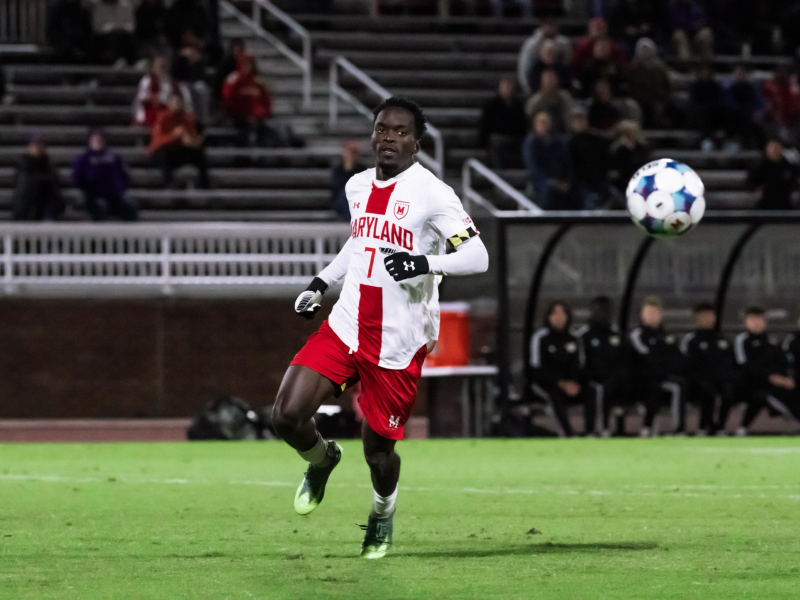
Conventional wisdom is nonexistent in the NCAA men’s soccer tournament. Sunday was a reminder.
Five of the top six seeds lost. Four of those matchups were decided by one goal. The other two, which includes Maryland, went to penalties.
No. 4 Maryland is the lone top-six seed to survive the second round, taking down North Carolina in penalties after goalkeeper Laurin Mack converted the winning kick. But Mack’s heroics overshadowed a pair of crucial performances during the 110 minutes preceding the shootout.
Rocket Ritarita’s reemergence
Nine Terps won various Big Ten honors after the team’s undefeated regular season.
Ritarita earned a spot on the conference’s all-freshman team despite a campaign featuring two contrasting stretches. The forward scored twice and assisted four times in his first four collegiate appearances — bookmarked by a perfectly timed run and chipped finish for a goal against Wisconsin on Sept. 12.
[Goalie Laurin Mack shoots Maryland men’s soccer past UNC, into NCAA tourney third round]
That goal in Maryland’s conference-opener earned Ritarita his first career start against Pittsburgh the next week, but it was an underwhelming introduction to the starting lineup.
Ritarita logged just one shot on goal across 58 minutes. Coach Sasho Cirovski reaffirmed his confidence in the freshman afterwards, describing him as “a nice blend of both Stephane [Njike] and Sadam [Masereka].”
Cirovski’s words were a partial testament to Ritarita’s versatility, given that he can play anywhere along the forward line. But as Masereka and Njike blossomed into Maryland’s most productive attackers, the freshman’s campaign went in the opposite direction.
Ritarita grabbed one goal contribution — an assist against Ohio State — across his next 10 appearances as his minutes dwindled.
The freshman finally broke out of the slump in a 12-minute cameo at the end of Sunday’s first half.
Ritarita ran onto a pass at the edge of the 18-yard box and took a first-touch, right-footed shot across his body. That effort beat UNC goalkeeper Andrew Cordes at the far post for Maryland’s lone score of the afternoon.
“We’ve seen that in training, so it’s something that we know he’s capable of doing,” Cirovski said. “It was just reward for a young man with great talent and great patience.”
Cirovski added Ritarita hasn’t gotten the playing time he’s deserved, given the quality of players throughout the team. Ritarita’s 36 minutes against the Tar Heels, though, were his most in a match since early October. The goal he produced during the time was a flash of the early-season form prompting his all-conference selection.
The impact of Masereka’s speed
Maryland played Sunday’s opening 45 minutes with a sense of urgency, which was absent toward the end of its Big Ten tournament loss against UCLA. Masereka embodied it.
[Maryland men’s soccer still set for deep NCAA tournament run after surprise UCLA loss]
The forward split time at all three forward positions, and Tar Heel defenders struggled to keep up with him regardless of where he played.
Masereka’s rapidness prompted Ritarita’s 43rd-minute goal.
The move started at the right foot of defender Jace Clark, who lofted a ball to Masereka as he sprinted past two defenders. By the time both Tar Heels caught up to him, Masereka stopped, pivoted and passed to a trailing Ritarita, whose ensuing score provided the senior with a primary assist.
It became Masereka’s lone box-score contribution as Maryland’s only forward or midfielder to play all 110 minutes.
Masereka’s Sunday stats — one assist, no shots on target and a missed penalty in the shootout — didn’t illustrate the impact of his speed. That trait forced Tar Heel defenders into tough decisions and harsh tackles, several of which could’ve been called fouls, but weren’t.
The havoc Masereka created was proof Maryland’s leading scorer can make a substantial impact without logging a goal.