Before the season, Maryland football offensive coordinator Pep Hamilton stood in front of reporters and shared areas of confidence for the team’s running backs.
Hamilton thought running backs like redshirt sophomore Nolan Ray and redshirt freshman DeJuan Williams would create a multi-dimensional offense, protect the quarterback and spark chances to win games.
None have materialized. The Terps boast the second-fewest rushing yards in the Big Ten, quarterback Malik Washington has 66 more passing attempts than any other player in the conference and Maryland is on a seven-game skid.
The defense hasn’t fared much better: the Terps have conceded at least 225 rushing yards in four straight games. The struggles in the trenches are a key reason Maryland loiters outside bowl eligibility for a second consecutive season.
[Sidney Stewart and Zahir Mathis formed bond through Muslim faith at Maryland football]
“All the top teams have the ability to run the football. We went into this year saying that that was a point of emphasis for us,” coach Michael Locksley said. “If you want to win, you have to run it.”
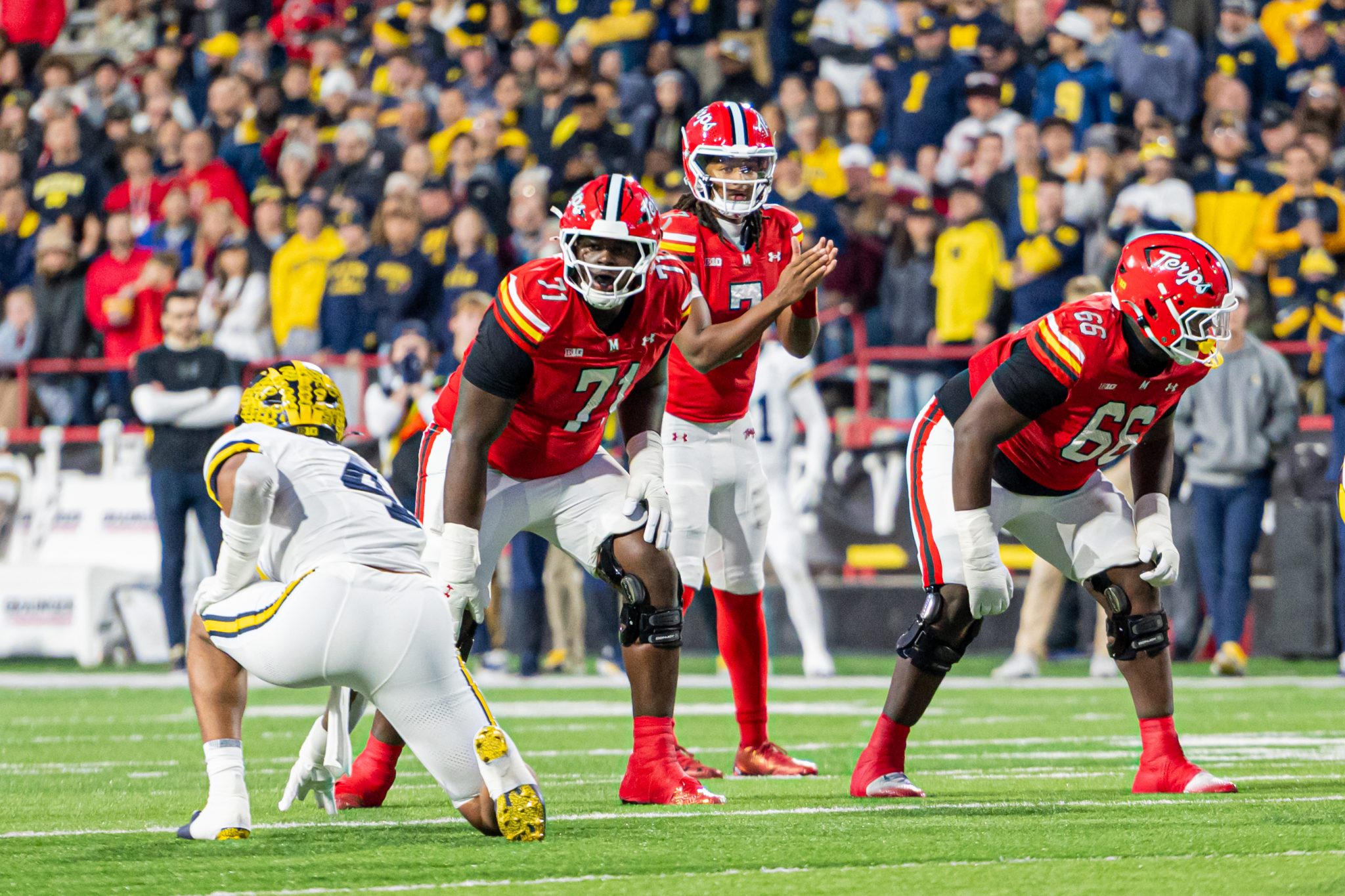
Locksley added that Maryland’s fastest rising position group is its offensive line, which ranks fifth nationally with only seven sacks allowed this season. The same five lineman have started every game.
But the Terps still rank in the Big Ten’s bottom-three in rushing yards for the third straight campaign. Ray has carried more than five times just once in conference play while Williams averages 3.7 yards per carry on a team-high 123 attempts. Each’s only rushing score in conference play came in a loss against Nebraska.
Maryland is also tied for last in the conference with six red zone rushing scores.
A few weeks ago, the Terps set up first-and-goal from Illinois’ three-yard line with a chance to trim a two-score deficit in the fourth quarter. Williams was stuffed on two runs, leading to a fourth-and-goal incompletion.
Against UCLA on Oct. 18, Maryland held a three-point lead in the third and passed three straight times within the Bruins’ five-yard line, resulting in a turnover on downs. Maryland lost the game by three.
It’s emblematic of the struggles around Washington this season.
[Jianni Davis hopes to standout from his father’s legacy for Maryland football]
The freshman’s four rushing scores match the rest of the team, and he holds their sole run of more than 30 yards with a 73-yard touchdown. Maryland has rushed for more than 75 yards just once in the last four games — a 305-yard outing against Rutgers. It was more than it recorded in its other four most recent contests combined.
“We had a really good run game against Rutgers and saw that as an improvement throughout the year,” center Michael Hershey said. “But coming into this offseason, we’re going to have to continually improve on the small fundamental things.”
While Big Ten teams are averaging about 157 rushing yards per game, the Terps haven’t held an opponent to fewer than 190 yards on the ground since Oct. 4. They sit last in the conference in time of possession.
On Saturday, Michigan rushed for 228 yards and passed just four times in the second half. Junior Bryson Kuzdzal, the team’s third-string running back starting due to injuries, went for 100 rushing yards and three touchdowns.
“The last few weeks has been a lot of what we call interior runs,” Locksley said after the loss. “Today, the ball came off the edge … we’ve got to a better job of forcing the ball back to where the help was.”
Dictating the trenches is typically a quality of strong Big Ten teams. Maryland hasn’t come close to proving that ability under Locksley, especially in recent seasons.