There’s an unwritten expectation in live theatre that intermission represents the passage of time. When patrons come back to act two, they’re now among characters who developed off-stage.
In Wicked’s stage production of Elphaba and Fiyero’s duet “As Long As You’re Mine,” the two characters grab at each other’s arms, caress their faces and kiss before a fade-to-black moment — expanding the urgency of their cause to defeat the Wizard with limited time left in the story.
But in the Wicked: For Good movie, the song becomes a slow sequence where the characters undress and move around each other. It tries to cram years of unexplored tension and desire into its runtime, not trusting its audience to understand the implications of time.
Wicked: For Good had flashes of brilliance in a bloodless adaptation. The original musical is no Cabaret or Les Mis in its intensity. But the story’s conclusion is overshadowed by flat acting, poor transitions and an identity crisis between the screen and the stage. When reviewing the first part last year, I wrote about how director John M. Chu would spring onto the audience with a shocking sequel adaptation. The bubblegum adaptation we received would be a facade.
But 2024 Sofia! Still reeling from the inability to purchase the Glinda Upland limited edition popcorn bucket without the matching plastic cup. You fool! It was I who received the nasty surprise of a PG-rated version of Wicked’s second act. Now, additional songs make subtext obnoxiously literal, and Elphaba wears a thick wool cardigan in a sex scene!
[Amid Grammys season, UMD students return to old favorites]
Returning from our year-long intermission, the film opens on Elphaba saving a cohort of Ox, members of Oz’s animal population who were silenced by the Wizard and Madame Morrible as they work on the yellow brick road. Glinda and Fiyero are now top officials in the Wizard’s administration. Elphaba’s sister, Nessarose, is now the Munchkinland dictator, holding her partner Boq hostage from visiting Emerald City.
Jarring changes, such as a tyrannical Nessarose and the newly engaged Fiyero and Glinda, can be forgiven when the stage confines time. While the film could’ve taken the time to remedy these character inconsistencies, it instead overexplains the witches’ motivations through two new original songs.
One is boring. The other is incredibly boring.
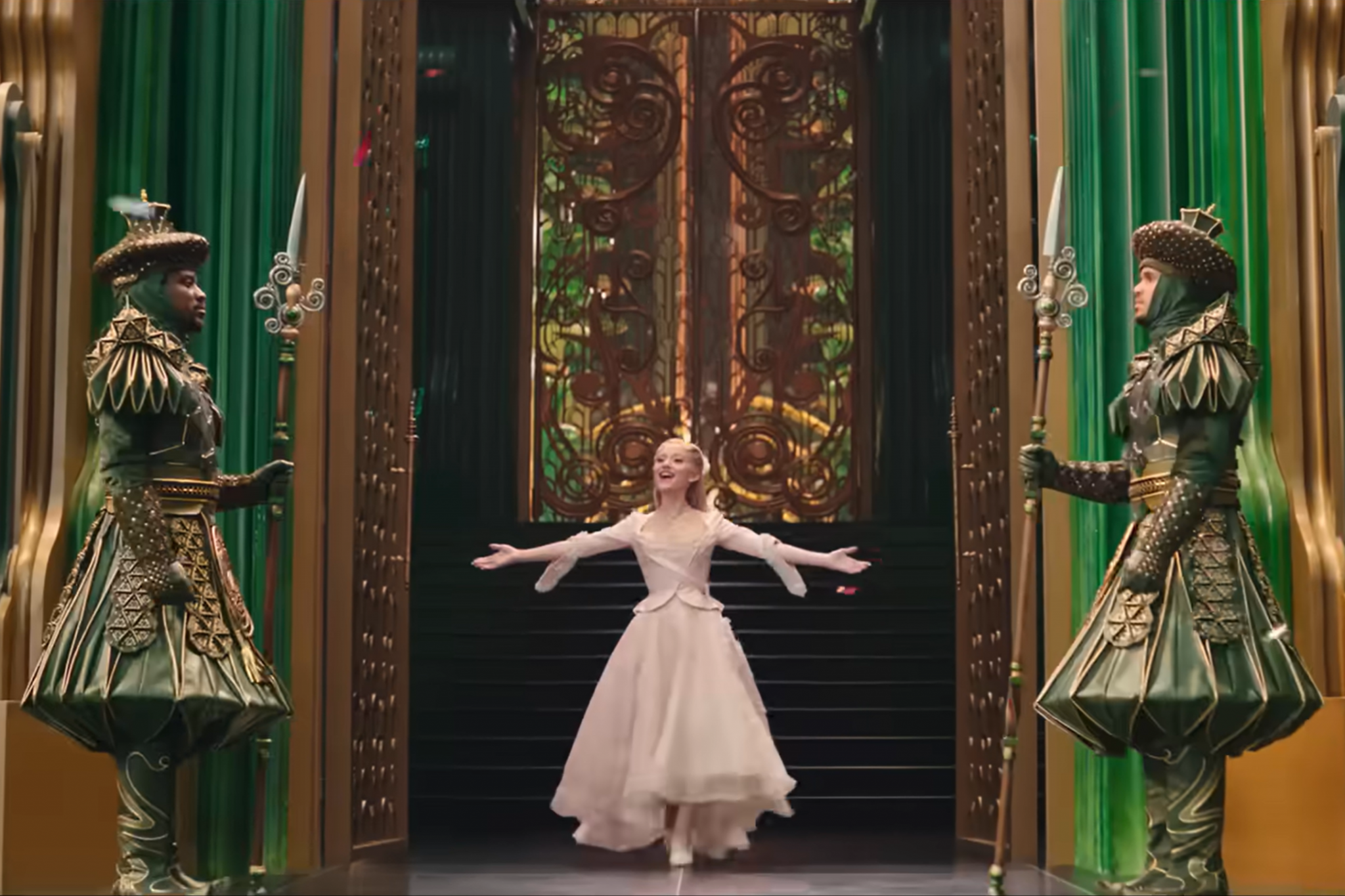
Ariana Grande’s standout moment from this film series is her rendition of “Popular,” so much so that she remains the same ditzy Glinda throughout the rest of the film. In Glinda’s grand number, “Thank Goodness,” Munchkinland’s moving foreground pauses around her as she delivers her speech as petals float around her head.
The scene attempts to reinforce her inner turmoil of becoming the dictator’s mouthpiece. Yet Grande’s acting remains in a shocked stasis, unaided by the massive set of lashes covering her eyes.
For Good tries again to clarify this in “The Girl in the Bubble,” an exhausting three-minute explainer of the double meaning in “Thank Goodness,” featuring too much on-the-nose lyricism.
The film is at its best when dark. Through darting eyes and pained expressions, Ethan Slater excels as Boq in his writhing transformation to the tin-man, brandishing an axe in Nessarose’s face in one terrifying scene. His cries for Elphaba’s death in “March of the Witch Hunters” are equally chilling.
[Have a vegan friendly holiday with these 6 Trader Joe’s snacks]
“No Good Deed” is the film’s standout number with a high-octane Elphaba wailing over Fiyero’s impending death sentence. The slicing of black-and-white shaking footage of Fiyero’s beating by Wizard guards, body transformation and Elphaba’s own descent into madness creates a seamless sequence of chaos.
The film’s murky sunset visuals allow for magical lighting from the grimoire and the terror of flying monkeys to resonate further with the audience.
The push and pull of theatre staging to film blocking comes through earlier, when the trio is together in a field before Fiyero’s arrest, rendering the moment slightly less intimidating than it should be. Still, the close-up of Glinda pressing her head to Fiyero’s gun hints to the dramatic actress Grande could be.
But it’s tough to imagine the fully-realized, darker vision For Good deserved, not when we must sell Chili’s margaritas and Wicked-themed Swiffers. Potentially not when Glinda’s wand might be a hot holiday commodity.
Any other tension is dispelled by the painfully draining performances of Michelle Yeoh and Jeff Goldblum.
When Elphaba confronts the Wizard about the extent of his animal rights abuses in one terrifying scene, Cynthia Erivo emanates a horror villain. All the while, Goldblum internally wonders what he’ll have for lunch. Yeoh, when she needs to be threatening to Glinda, finger-wags her way through the scene.
Fortunately, Chu sticks the landing with “For Good,” creating an emotional sphere of both audience and film ensemble to grieve the end of this journey. In this moment, urgency is abandoned and Wicked lovers can appreciate its big-screen presence.
Despite its flaws, For Good’s inevitable success will signal a new era for the movie musical, much to the excitement of overlooked theatre nerds everywhere.