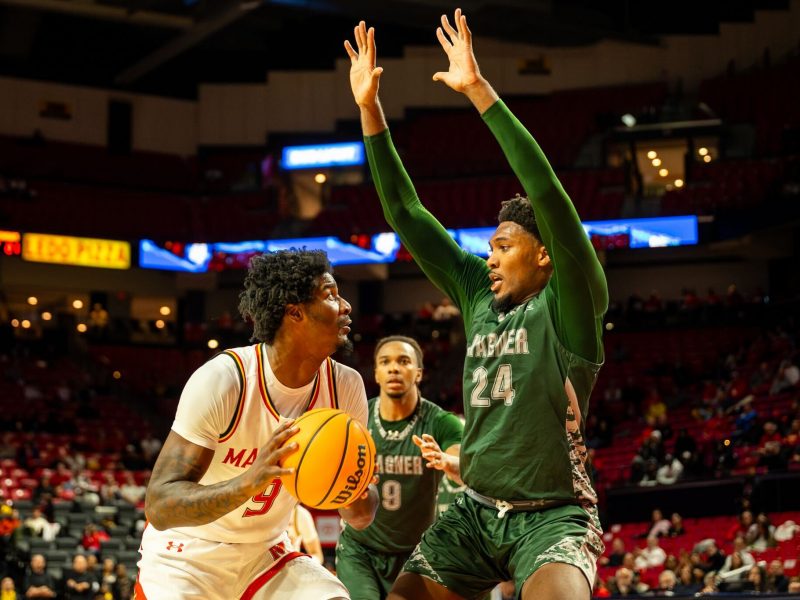
At 6:21 a.m., nearly seven hours before Maryland men’s basketball tipoff against Marquette, Buzz Williams gathered his players around a TV. Before the morning shootaround at the Fiserv Forum, the Terps’ coach watched rebounding clips with his revamped roster.
He pointed to rebounding as a significant area of concern after Maryland’s first few games. That’s particularly surprising for a Williams-led team, who consistently coached some of the best rebounding teams in the country.
The problem was exacerbated against Marquette. The Terps were outrebounded, 20-4, on the offensive glass Saturday. The Golden Eagles claimed the game’s first 15 offensive rebounds and scored 25 second-chance points, albeit in a 89-82 Maryland win.
“It takes an enormous amount of time,” Williams said. “We are beyond bad at [rebounding], not just against Marquette.”
Williams began the game-day ritual of watching rebounding film two years ago at Texas A&M.
Maryland has 174 “buckets of responsibility,” a system designed to delegate different areas of the game to various members of the Terps’ revamped coaching staff. Williams, though self-admittedly leading the fewest number of “buckets,” is responsible for rebounding.
The project has become “all-consuming,” Williams said. To him, rebounding is a margin that revolves around effort and promotes aggression — often a rarity in modern college basketball.
[Pharrel Payne suffers gruesome injury, but Maryland men’s basketball beats Marquette, 89-82]
But Williams’ initiative hasn’t translated from film sessions to tangible results for the Terps.
“If you saw all the drills we did for rebounding, you would think we’re putting on a coaching clinic,” Williams said. “But we are not executing it well at all.”
Foul trouble and a gruesome injury limited senior forward Pharrel Payne to play a season-low 17 minutes in Maryland’s win over Marquette. Through the Terps’ first four games — prior to exiting on a stretcher midway through Saturday’s second half — Payne has accounted for nearly a fourth of the team’s total offensive rebounds, a concerning trend now that his status is unknown.
Payne, bolstered by his 6-foot-9, 250-pound frame, anchors nearly all of Maryland’s paint touches and offensive rebounds after misses from beyond the arc.
After pouring in a season-high 15 second-chance points in the Terps’ Nov. 7 loss to Georgetown, Maryland’s rate has drastically diminished. It barely managed double-digits against an undersized Alcorn State squad on Nov. 11, then scored a season-low six second-chance points against the Golden Eagles on Saturday.The Terps so far average about eight offensive rebounds a game this season — an abysmal mark that puts them in the bottom third of 365 Division I schools and the sixth-worst rating among Power Four teams.
[Why Maryland men’s basketball’s offense hasn’t clicked]
“How are we going to establish some level of program not based exclusively on talent, and how could we create a niche that would give us some guidance on how to recruit?” Williams said, referring to what he said he learned coming out of the COVID-19 pandemic.
Williams’ rebounding mindset has resulted in a repeated theme across each of his three previous high-major stops.
Texas A&M’s all-time best rebounding margin at 13.0 came in 2023-24 with Williams at the helm. The same year, the Aggies set a program-high with 1,541 total rebounds and led the SEC in average offensive boards at 17.4.
In the 2018-19 season, the final season of Williams’ tenure with Virginia Tech, the Hokies finished 78th in the nation in total rebounding rate — a drastic increase from their 239th overall slot the year before. Marquette’s Big East single-game rebound record at 54 came in 2014, also under Williams.
Now without his star big man and lone rebounding source for the foreseeable future, Williams is forced to navigate another solution amid a notable size discrepancy in Maryland’s weakened frontcourt.