Despite the University of Maryland Senate voting in favor of uniting with other Big Ten schools against the Trump administration, the university has yet to initiate a mutual defense compact.
In response to President Donald Trump’s attacks on higher education, the university senate passed a resolution in April that supported establishing an alliance between Big Ten universities. The resolution called on university president Darryll Pines to formally propose and help create the compact in order to defend academic freedom, institutional integrity and research.
The resolution also asked member institutions to contribute to a shared defense fund that would help provide support to any member institution in the case of legal or political attack.
The resolution came after several faculty senates at other Big Ten universities called for the schools to form a coalition against the Trump administration. This university’s resolution was authored by senator and fire engineering professor Peter Sunderland and was adapted from Rutgers University’s original resolution.
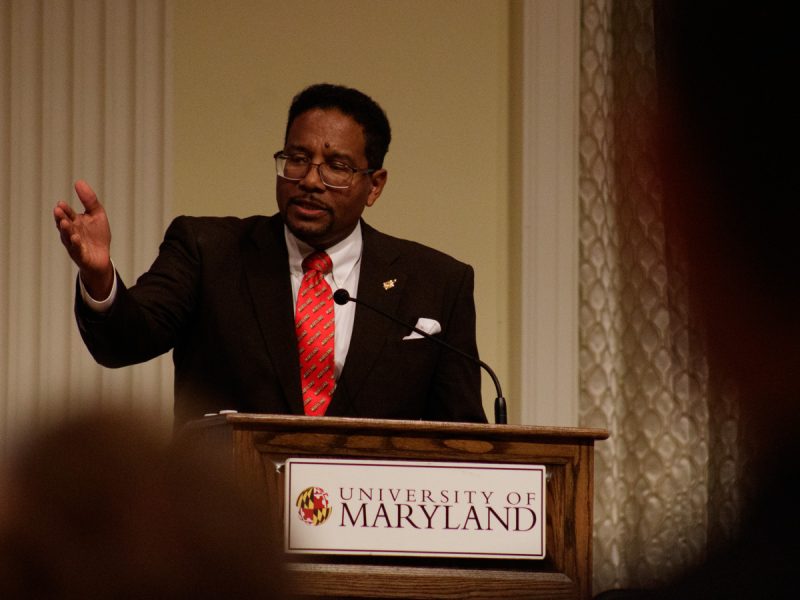
Pines told The Diamondback in November that he has yet to receive any further communication on behalf of the university senate since senators voted in favor of the compact in April. Pines added that he doesn’t need to sign on to show his approval of it.
[UMD president Darryll Pines discusses federal pressure in State of the Campus address]
To form the compact, a Big Ten university president with a senate supporting the resolution must initiate and work with administrations at other universities in the academic alliance.
“I support what the University Senate wants to do, I think they’re a body that is shared governance,” Pines said. “I support their focus on what they think is best for faculty, staff and students.”
The university referred to Pines’s comments when asked if the university took any additional action in establishing the compact.
Fourteen of the 18 university senates within the Big Ten have passed resolutions in support of their universities joining the compact, according to Paul Boxer, who co-authored Rutgers’ resolution.
But the presidents of these universities, including Pines, have not yet initiated the compact.
Boxer, a psychology professor and university senator at Rutgers, authored the original resolution with fellow senator David Salas-de la Cruz, a chemistry professor at Rutgers’ Camden campus.
Boxer said he has been appreciative of the support Pines has shown for the compact but was hoping to see more action.
“I get it,” Boxer said. “It’s not an easy task to undertake for someone in that position.”
Sunderland reached out to Boxer after hearing about the compact in the spring and expressed interest in creating his own resolution urging this university to start the compact. He then met with Boxer to discuss strategies and goals behind presenting the compact and resolution to the University Senate.
[University Senate votes in favor of uniting with other Big Ten schools against Trump]
Sunderland said he isn’t worried about the compact’s progress and recognizes that the university administration might be tackling topics requiring more immediate action, such as canceled grants.
If Pines does attempt to push back against the Trump administration, Sunderland said he has the support of faculty and staff.
Sunderland said he wanted to author this university’s resolution because it upset him to think any university would give up academic freedoms, including speech, because of the federal government. Voting for this resolution, he said, was the senate’s way of resisting attacks from the Trump administration.
“If you’re fighting one person, it’s pretty easy,” Sunderland said. “But if you have to fight a whole bunch of universities at once, and they all are coming back with the same message, it definitely slows things down.”
While Sunderland wished Pines was doing more to establish the mutual defense compact, he said he was happy the university president spoke out against signing onto the Department of Education’s compact sent to nine U.S. universities in early October.
This university has not been requested to join, but Pines told members of the senate last month he wouldn’t sign on to the proposal if the university were to be sent a similar letter.
Universities that signed the department’s compact receive benefits including access to federal research funding, student visa approvals and preferential tax treatment in exchange for agreeing to make numerous policy changes.
The changes included ending “discriminatory admissions processes” based on students’ identity and agreeing to transform or abolish any practices that discriminate against conservative ideas.
Sunderland, who was at the senate meeting in October, said he was smiling “cheek to cheek” when he heard Pines say he would not sign onto the education department’s compact.
Assistant news editor and administration reporter Sam Gauntt interviewed university president Darryll Pines for this story.