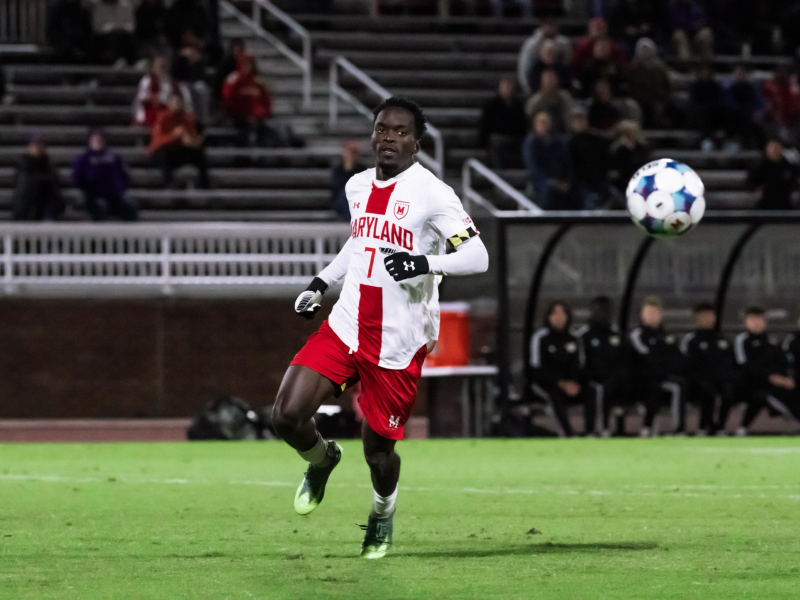
UCLA men’s soccer created virtually no offensive chances in the first half of last week’s match against then-No. 18 Maryland. The Bruins took one shot; it happened 29 seconds before halftime, and the attempt harmlessly rolled wide of the goal.
So, with the second half kickoff, it would have been easy to assume UCLA would be more aggressive. It did the exact opposite.
Defender Allan Legaspi ran up to the ball and launched it toward the left sideline. Maryland right back Farouk Cisse watched the ball sail over his head and took the ensuing throw-in just a few seconds later.
Cisse was unfazed by the perplexing kickoff. It’s a resurgent strategy that the Terps have become privy to. But the Terps don’t use the intentional kickoff to boot it out of bounds, opting for a more traditional approach.
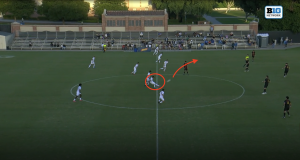
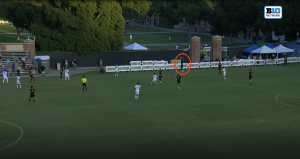
“A lot of teams either kick it out of bounds, and pin you in for a corner, or they kick it into your end and try to re-press,” coach Sasho Cirovski said. “It’s a territory play.”
Maryland has taken virtually all 16 kickoffs this season in identical fashion.
[No. 18 Maryland men’s soccer stifles UCLA — and itself — in 0-0 draw]
Whichever forward is playing centrally — usually Luke van Heukelum or Rocket Ritarita — passes the ball backward to defensive midfielder Chris Steinleitner or center back Lasse Kelp. The Terps usually follow one of two habits from there.
About half of the time, Steinleitner or Kelp turn sideways and pass to another defensive player. That typically starts a string of passes around the back line — with goalkeeper Laurin Mack sometimes getting involved — before someone finds a lane to advance the ball into midfield.
The Terps’ other approach is more direct.
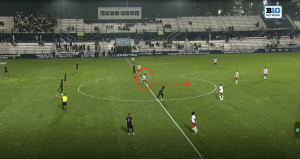
Kelp or Steinleitner first takes a touch after receiving the initial pass. Stopping the ball allows the Maryland attackers an extra second to sprint downfield. It also simplifies the next move for Steinleitner or Kelp, since it’s easier to deliver an accurate pass.
They then loft a pass down the field to one of Maryland’s forwards in the hopes of winning a header or control possession and making a run at goal.
Both kickoff approaches rely on clean passing between all three levels of the team’s common 4-3-3 formation. They also allow the Terps’ defensive players to start attacks, which is Cirovski’s preferred offensive philosophy.
Maryland’s system requires diversely skilled defenders.
[Maryland men’s soccer thrives on passion, loyalty from The Crew]
“If you don’t have players at the back that can play [with the ball], then you minimize their effect,” Cirovski said. “We maximize the effect of our players at the back.”
Staying composed is also important to handle UCLA’s kickoff method.The Bruins’ tactic is based on a trade-off: they would rather try and generate a turnover in the attacking end by punting the ball away rather than guaranteeing possession with a simple pass off the kickoff.
That’s why a cohort of UCLA attackers and midfielders swarmed the left side of the field where Cisse was taking the throw-in. But Maryland broke that press almost instantaneously.
Cisse tossed the ball to junior Leon Koehl, who volleyed it to the opposite half of the pitch. It forced the Bruins to restart their attack from the backline — essentially the same outcome they would’ve produced by simply playing the kick-off to one of their defenders.
The technique is trending across college soccer. While multiple teams are implementing the new strategy in hopes of forcing opponents into critical mistakes, Maryland is sticking with a more traditional method.
Cirovski has been praised for his innovation during his tenure in College Park. But the coach has chosen to stick with the tactic he’s used across his 33 successful seasons at Maryland. His team has an undefeated record to show for it.