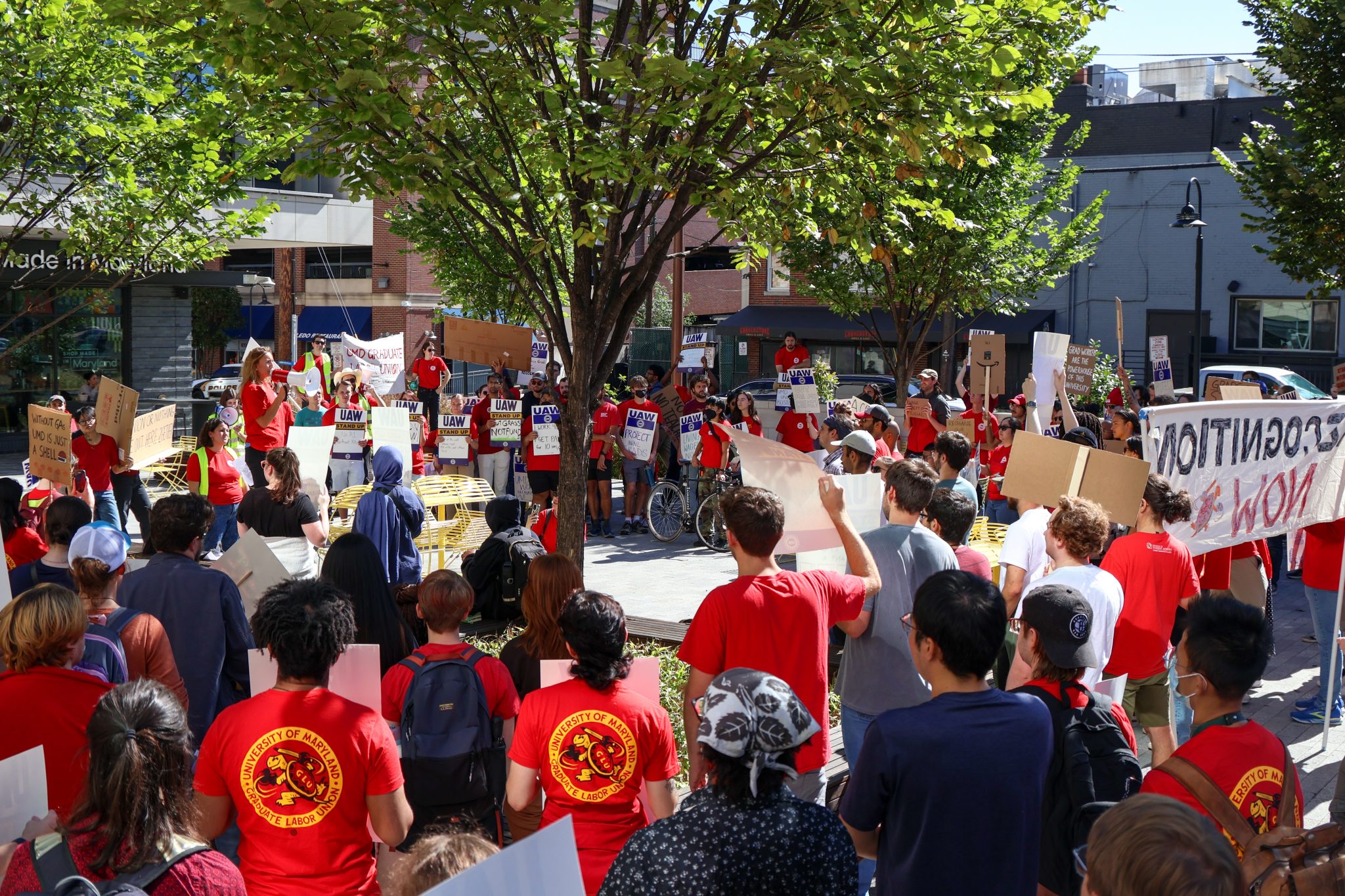
About 1,000 University of Maryland community members gathered Wednesday to demand collective bargaining rights for graduate workers.
Protestors marched along Route 1 to College Park City Hall and called on this university to voluntarily recognize graduate workers’ right to unionize and begin collective bargaining with the Graduate Labor Union, which would allow them to negotiate stipends, working hours and other conditions.
“For our union we will fight, ignore us if you want a strike,” participants chanted during the march.
Organizer and education doctoral student Cody Norton said Wednesday’s protest was a continued escalation of previous action demanding voluntary recognition from the university.
“We want to be collaborative, and we are happy to do that when they recognize our right to unionization,” Norton said.
Voluntary recognition is when an employer acknowledges a union once a majority of employees show support, according to the U.S. Department of Labor. More than 2,300 graduate workers accounting for nearly 57 percent of the graduate workforce have already signed union authorization cards, which signal their desire to join the union, computer science doctoral student Sora Cullen-Baratloo said.
[UMD SGA passes act urging university to recognize Graduate Labor Union]
The march culminated in speeches in front of City Hall and the unveiling of a letter that the workers plan to send to university president Darryll Pines after collecting 2,000 signatures. The letter emphasizes the importance of graduate workers and cites other schools across the country that have allowed unionization.
“Until we have a democratic and legally binding voice to help the university to live up to its stated values for its students and employees, we will continue to take whatever actions are necessary to secure our fundamental right to a recognized union,” the letter read.
Striking is also a possibility if the university fails to meet the group’s demands, Norton said.
“If the university again refuses to recognize our fundamental right to unionization, then the next step forward is likely going to be withholding our labor through some sort of labor stoppage action,” Norton said.
This university’s administration has repeatedly testified against bills in the Maryland General Assembly that would grant graduate student workers the right to collectively bargain, which is not currently required by state law.
Though this university did not provide direct comment on the march, it said in a statement to The Diamondback that the administration “continues to work closely with the Graduate Student Government, the Graduate Assistant Advisory Council, and other student groups to identify student concerns and work to find common ground in advancing improvements.”
The fight for collective bargaining rights is especially important amid U.S. President Donald Trump’s attacks on science funding and higher education, event organizer Jeremy Shuler said.
[UMD GSG hopes to support international students, fill vacant seats this year]
“Fundamentally, [collective bargaining] forces the university to have a contract with graduate students and bargain with graduate students, so that we will be present whenever [the] university makes a decision about us, and we’ll be there to make sure that they sufficiently respect what we want,” Shuler, a graduate research assistant for the physics department, said.
Graduate students have marched across campus in the past, but this demonstration took place off campus to show that the movement is larger than the university and to avoid university protest regulations, Cullen-Baratloo said.
A number of graduate workers and community members spoke during the gathering at City Hall, including masters student Jenan El-Hifnawi, who spoke about the struggles many graduate students face from their limited stipends.
“Nobody working full time at a university should be struggling to pay rent or feed themselves,” El-Hifnawi said during her speech.
Cullen-Baratloo said she thought the march went “really well” and left the demonstration feeling “pumped.”
“I really hope they just decide to recognize our union,” Cullen-Baratloo said. “I think it would kind of save the university a lot of headache. It would save us a lot of headache, and then we could begin bargaining as soon as possible.”