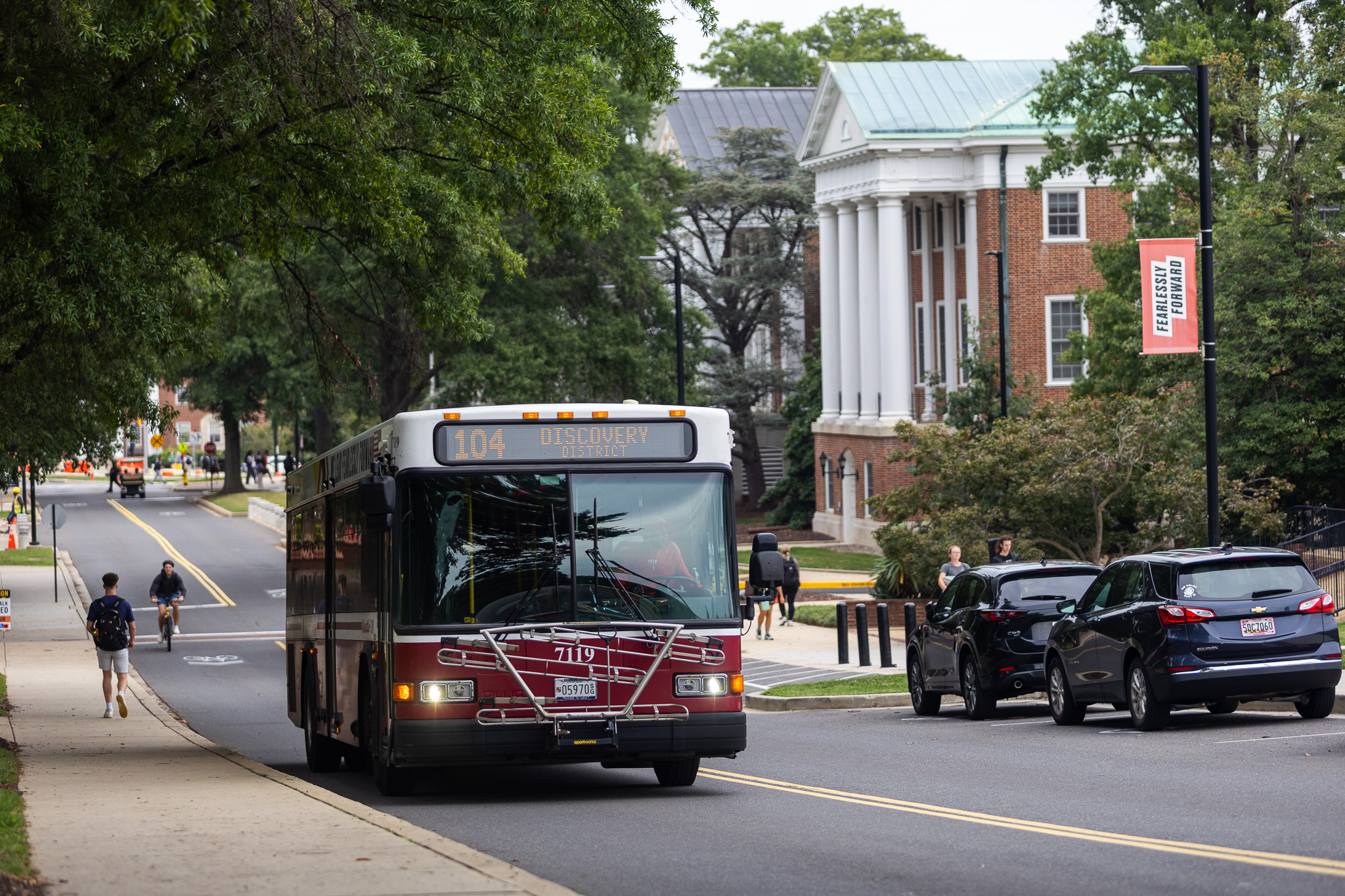
A recent decrease in frequency of certain Shuttle-UM routes has led to some University of Maryland community members facing longer commutes and taking multiple buses.
This university’s Department of Transportation Services told The Diamondback in a statement the new bus schedules were created to organize driving resources such as staff, vehicles and hours of service efficiently.
The department looked at how it would affect service, as well as looking at ridership and cost efficiency, when making this decision, DOTS wrote in the statement.
The changes had multiple impacts to service frequency and stop locations, according to DOTS. The changes also consolidated the former 128 and 129 into the 128 Mazza GrandMarc/Tempo route.
Some routes, such as the 118 to Graduate Hills, South Campus Commons 1 & 2 and the Regents Drive Garage, have added more stop times.
But others, such as the 111 to Silver Spring, stop less frequently. During the fall 2024 semester, the bus stopped at each location twice in the morning and ran from 7:55 to 10:25 a.m.
The bus now only stops at each location once and runs from 7:10 to 8 a.m. The bus also no longer stops at Takoma Langley Crossroads Transit Center in the morning.
[UMD RHA discusses goals for community engagement, collaboration at first senate meeting]
The 111 runs from 12:10 to 1:45 p.m., similar to its past schedule, but no longer stops at each location twice in the evening.
It runs from 6:15 to 7:05 p.m., as opposed to last fall, when it ran from 5:40 to 8:20 p.m. The bus no longer stops at the Takoma Langley Crossroads Transit Center stop in the evenings.
Zainab Jeffrey, a second-year theatre and performance studies doctoral student, said she was used to the five daily times the bus ran.
She now has to take three buses after the reduction in frequency in order to commute to and from campus from Silver Spring.
Jeffrey’s commute now takes an hour and 15 minutes, instead of 30 to 45 minutes, and requires her to transfer at Takoma Langley Crossroads Transit Center, which she said is unsafe.
Thinking about transfers on her new commute also takes a mental toll, she said.
“I’m coming to a point [where] I’m slightly used to this, but I don’t want to be,” Jeffrey said.
Brian Crawford, a coordinator in the dean’s office of this university’s arts and humanities college, also took the 111 regularly.
The new operating hours mean those using the route could spend 10 to 12 hours on campus, he said.
Crawford now also takes multiple buses to get to campus, he said, making his commute hours long.
“I end up having to be on campus … more than I’d like,” Crawford said. “Some days, maybe I’m not able to get to campus at a reasonable time, because [the bus that was] supposed to show up didn’t show up.”
[UMD SGA passes act urging university to recognize Graduate Labor Union]
Fourth-year physics doctoral student Bramwell Shafer also takes the 111. Unlike previous semesters, Shafer can only take the one back to his home in Langley Park.
“It’s just, I guess, a little frustrating,” Bramwell said. “[The change in hours] kind of makes it very inaccessible for a lot of people.”
Other routes such as the 108 to Adelphi, the 113 to Hyattsville and the 126 to New Carrollton have also faced reductions in bus frequency.
DOTS encouraged commuters in a statement to The Diamondback to read the department’s website for transit resources.
“We understand that any adjustments in service can create challenges for members of our community,” DOTS wrote in the statement. “We remain committed to improving transit options and will continue to explore ways to increase service options.”