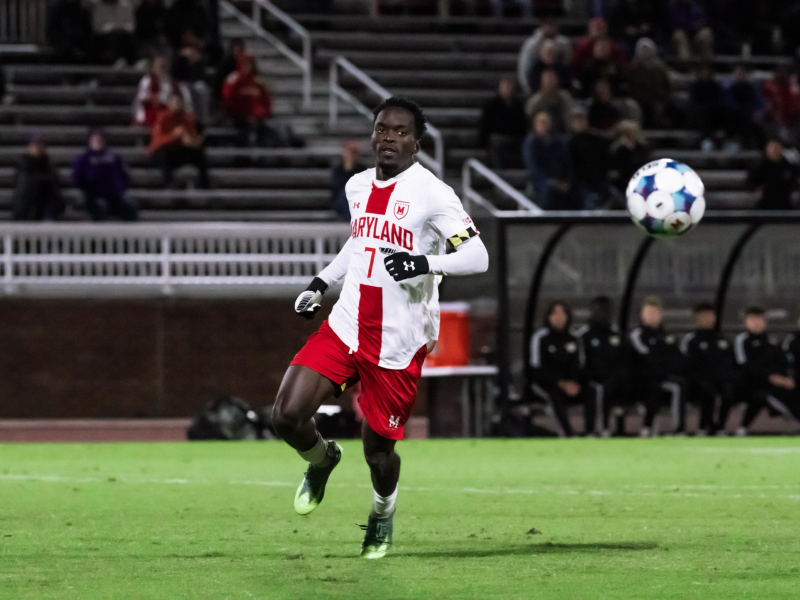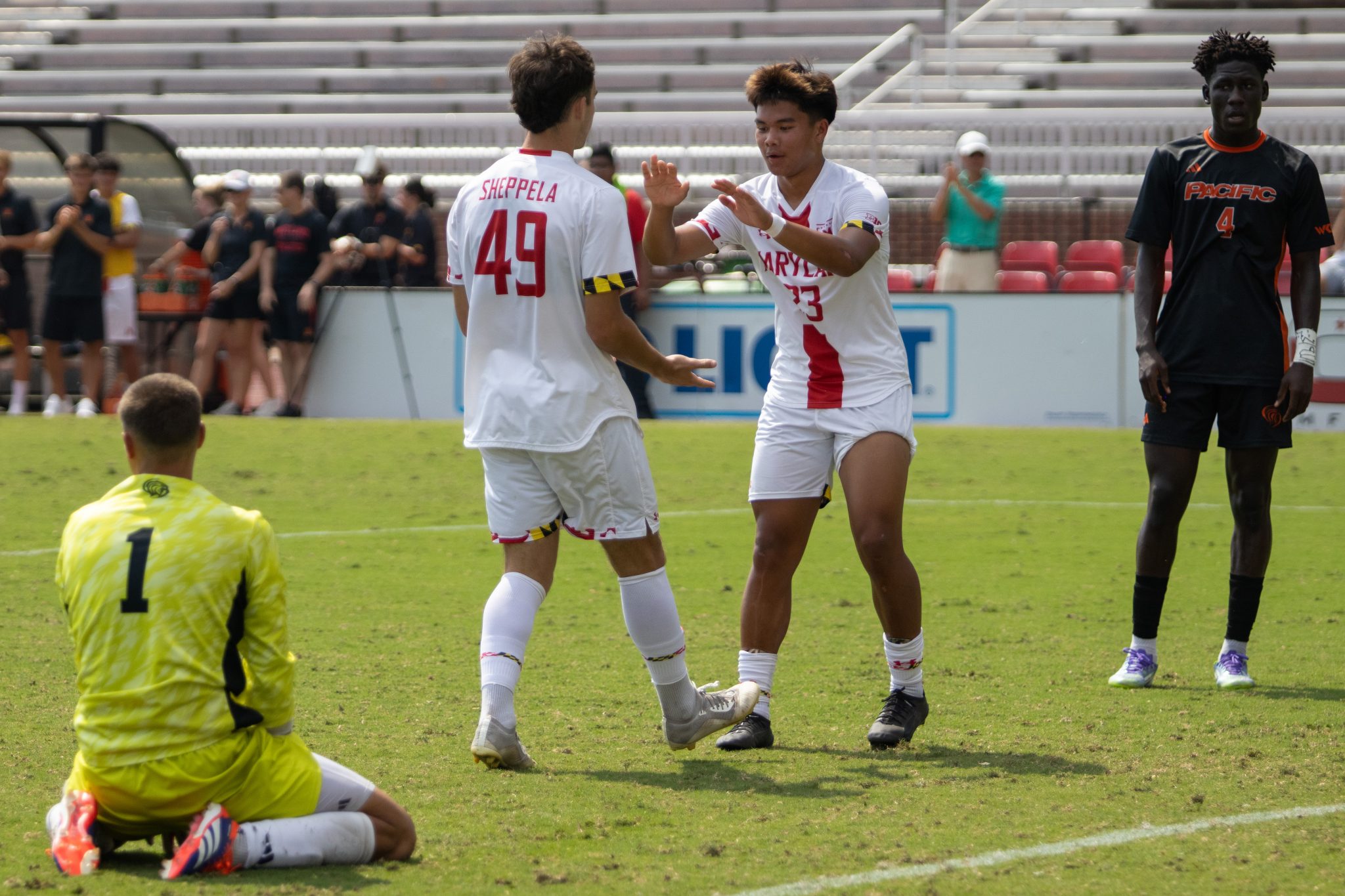
Maryland men’s soccer’s Sasho Cirovski frequently uses the word “depth” when talking about the roster he recruited. The Terps’ coach of 33 years often cites it as aprimary reason for his team’s late-game scoring trend.
So far this season, Maryland has scored seven goals in the 70th minute or later. It did that just eight total times last season. That’s been the key difference in a Terps’ attack that remains persistent until the final whistle — a trait emblematic of the team’s offensive depth.
“There’s 11 starters, but I’d say we have more like 15 [or] 16 guys that are at the level,” midfielder Albi Ndrenika said. “Being able to keep that level up for 90 minutes is a huge advantage.”
Seventeen of the 21 outfield players who’ve seen time on the pitch have recorded at least one goal or assist. FreshmanRocket Ritarita and seniorMatias de Jesus have been at the forefront of that.
In 129 minutes, Ritarita has scored twice and assisted a team-leadingfour times. His contributions are spread across Maryland’s three most recent games, with Ritarita tallying all six goals or assists after the 75th minute of those respective matches.
[Malik Washington has Maryland football fans dreaming big 3 games in]
de Jesus records fewer counting stats from the midfield but impacts games with his intensity. He best displayed that spark-plug skillset in a three-assist showing against Saint Francis.
The senior was subbed on in the 24th minute against the Red Flash. A stagnant Maryland attack took just two shots prior to de Jesus’ appearance. The Terps finished the half with 13.
The veteran midfielder put defenders under pressure by challenging them in one-on-one situations, an approach that created space for his teammates. de Jesus also took three shots in that half, one of which deflected directly to forward Luke van Heukelum for a tap-in goal.
The cohesion between Maryland’s starters and reserves has been most evident late in games, as proven by the group’s pronounced second-half output this year.

While Maryland’s bench of starting-caliber players is a luxury, the 11 that regularly start games still provide the most consistent production.
[The Diamondback Sports Digest: Maryland football faces its first conference test]
Sophomore Stephane Njike, junior van Heukelum and senior Sadam Masereka form a front that’s combined for seven goals and three assists. Each member of the trio offers a different challenge to opposing backlines.
“Luke’s a deadly finisher, Sadam can get in behind with ease, Steph[ane] can create with the ball at his feet or [get] in behind,” Ndrenika said.
Cirovski appears to strategically manage the minutes of his three primary forwards.
Njike and Masereka both average about 70 minutes a game. That same figure is exactly 45 minutes for van Heukelum. The rotation helps all three remain sharp — relative to the defenders they may face — deep into games.
Maryland’s 4-0-1 start to the season has afforded Cirovski ample opportunity to praise his team’s depth, but this isn’t anything new.
Before the season started, Cirovski proclaimed this year’s squad could be the deepest he’s had since the 2018 national championship team. That hasn’t proven to be exaggerated thus far, but the Terps’ coach also knows it’s too early to assign NCAA title expectations to the 2025 group.
“That [2018] team started slow and won a national title,” Cirovski said. “We’ll see how this team goes. They’re still writing their story, and we’ll answer that question later.”