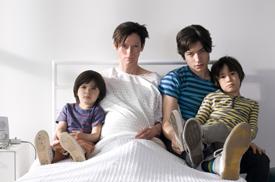

For a movie about a teenager who shoots up his school, We Need to Talk About Kevin spends precious little time in the actual building — but that doesn’t make the film any easier to stomach.
The movie, which is based off a 2003 book of the same name, spends most of its time following the titular character’s mother, played by Tilda Swinton (I Am Love), both as she tries to come to grips with the murders and as she rears a young Kevin.
The amount of time spent in the present is negligible — instead, director Lynne Ramsay slides non-linearly between the murders’ aftermath and offers what might have caused Kevin to do it.
While young, Kevin (Ezra Miller, Another Happy Day) shows symptoms of autism, remaining silent until he’s older and wearing diapers until he’s eight. He grows a healthy distaste for his mother, in which she is largely complicit. He seems to love his father, played by a barely-there John C. Reilly (Tim and Eric’s Billion Dollar Movie), but has a certain uncomfortable, sneering contempt for everyone bubbling underneath.
Miller manages to make Kevin more than a sniveling, awful teenage caricature, using his minimal screen time to imbue his character with a special sort of creepiness, and Swinton excels as both a frustrated young mother and, later, as a person ostracized from society, as much of a victim as the classmates Kevin took down.
In fact, some of the most painful scenes are the ones that come in the aftermath of the murders, as a lonely Swinton has to avoid mothers of victims in the supermarket and face the penetrating stares of the rest of the town. Another film might have made a spectacle of the act itself; this one is pure psychology.
To accomplish that, Ramsay presents the movie as more of a series of character-building vignettes than straightforward plot. To anchor the audience she uses repetitive sound and color cues — the use of red is particularly striking — to paint a picture that is only fully visible as the film ends.
At times, the audience is left to try and figure out exactly when a lot of the scenes occur, and why they’re presented in the order they are. For a patient viewer, it can be immensely rewarding. But for one who wants lights-and-sounds action, it’s easy to discount.
Basically, Ramsay presents all the information, lets the audience decide how to process it and to decide on which characters the blame should lay, if any. It’s an effective move, and perhaps the best way to disorient and disturb those watching.
VERDICT: A difficult but rewarding viewing, We Need To Talk About Kevin makes the most disturbing part of a school shooting everything that happened before it.
jwolper@umdbk.com