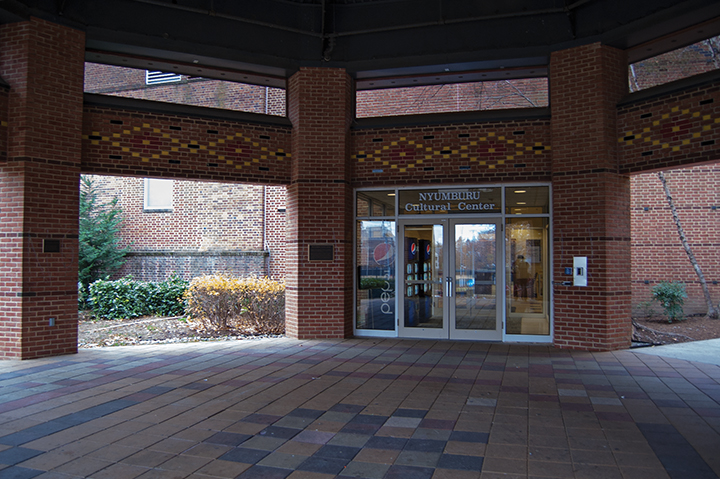

Nyumburu Cultural Center, founded as a black social and cultural center in 1971, plans to expand its campus reach by partnering with other student groups.
Founded in 1971 as a center for black social, cultural and intellectual interaction, the Nyumburu Cultural Center plans to expand its reach on the campus by pursuing partnerships with other student organizations.
A review and subsequent report by the Office of Diversity and Inclusion last semester concluded that students who never visited Nyumburu thought its services were useful but not geared to their needs. Although a variety of student groups already use the center, Director Ronald Zeigler said, formalizing partnerships with other groups would promote Nyumburu as a multicultural space and dispel perceptions that the center caters exclusively to black students.
“Some folks do not come here because they have, in my opinion, a twisted perspective in terms of what we offer,” Zeigler said. “There is a sizable portion of students of different political, sexual and ethnic persuasions who feel there isn’t a place for them, or only a limited place for them, on campus.”
The center offers a variety of services and programming, from credited classes to musical events. Officials plan to implement a series of new initiatives and expand some existing programs at the center to attract a more diverse group of students.
One new program, for example, will focus on “the complexities of sexuality, biracialism and identity for college students,” Zeigler said. Although the details are still in flux, the program likely will include speakers, workshops or conference trips.
The center will also increase advertising for other services that existed in some form before the review, such as a Swahili class taught by a linguistics student volunteer, in the hope of bringing together a more diverse group of students, Zeigler said.
To help fund the new initiatives, the center submitted a request for a $1-per-semester increase to the $18 student fee that supports the center. Fee requests aren’t finalized until the end of the academic year, but officials will begin implementing the new programs during the spring semester and work within their existing budget, Zeigler said.
Student Government Association diversity director Joseph Ehrenkrantz is building an advisory committee of student group representatives to gather student input on the center’s expansion efforts. The groups represented on the committee will brainstorm ideas and provide feedback on how best to ensure students from different communities feel comfortable and able to take advantage of existing resources on the campus.
“The challenge for diversity on campus is making the university feel like home for everyone everywhere,” Ehrenkrantz said. “What [Nyumburu does] to build space for a community on campus is fantastic, and that’s something I’d like to see for all other student groups as well.”
Nyumburu and religious centers such as Hillel and the Catholic Student Center provide a familiar, comfortable space for students in those communities, but other groups on the campus lack such places, he said.
Jada Harrison, a junior community health major who has worked at Nyumburu since her freshman year, said while she supports the center’s inclusiveness, she is concerned that expanded outreach could dilute the center’s foundational focus.
“I don’t think it’s necessary to expand beyond students of the black diaspora, only because there are other venues for those students in contrast to what [Nyumburu] was founded as — a place for African students,” Harrison said. “I think Nyumburu is just fine the way it is.”
jloguedbk@gmail.com


