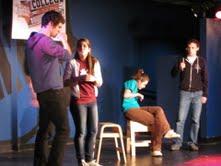

Four members of Erasable Inc. — from left, Natalie Herder, Zach Latta, Madeline Whiting and Jay Kasten — performed and won fourth place at the 2012 College Improv Tournament National Championships in Chicago on Saturday.
Every Friday at 1 p.m. a crowd gathers on the steps of McKeldin Library, attracted by the yelling that can be heard across the campus. It’s not a protest or a break-up but Erasable Inc., an improv group that invents scenarios and plays games based on suggestions from the audience.
On the campus, the members of Erasable Inc. are known mostly as “the people on the mall,” but nationally, they’re now known as one of the best college improv teams in the country after coming in fourth place at the 2012 College Improv Tournament National Championships in Chicago on Saturday.
The competition was set up playoff style, with 16 teams — whittled down from the original 126 that competed in 13 regional competitions — vying for four spots in the championship round. The three teams that beat Erasable Inc. were also the top three in last year’s competition.
The four members of Erasable Inc. who competed in Chicago said the home support made them feel more comfortable in an environment where there were mostly local teams who had a lot of fans in the theater. The six other members of the group and all of Sketchup, a sketch comedy group at this university, watched the competition through a webcam stream and sent encouraging text messages throughout the day.
The positive feedback from the other teams at the competition didn’t hurt either.
“The other teams were really, really nice,” said senior psychology major Zach Latta. “This type of improv is so collaborative that they tend to be that way. It is almost weird how kind everyone is to each other.”
“It was cool to feel the support and love from the improvisers,” junior theater major Madeline Whiting said. “We earned a lot of respect yesterday.”
n n n
“You want to warm up?”
“Yeah, what did we do last time?”
“We punched things. We did karate closet … KARATE CLOSET!”
“Hu hu phew phew phew phew.” Legs kick carelessly. “Ah ah ah ah oooh ooh ooh yahhhh.” Hands karate-chopped through the air. “Hi yah. Hi yah. Hoi hoi hoi. Mah mahh mahhh mahhhhhh.” Arms reach up toward the sky. Boom. Contact.
“Doorsteps always inhibit karate closet,” senior marketing major Jay Kasten explains as three other members of Erasable Inc. continue screaming and grunting at the door of room 2309 in the Art-Sociology building.
Karate closet is just a preview — a way to shake out any instinct to behave normally and channel all their creativity for the next 20 minutes of long-form improvisation.
They have been practicing for months (always Sundays but at least two other days per week as well), and the performance changes drastically every time because they only know one element of their story in advance.
“Excellent, we are Erasable Inc., and all we’re going to need from you is a place to work,” Kasten says to the room of orange plastic chairs, empty except for sophomore computer science major Geoff Little and freshman biology major Brandon Schatt. (Erasable Inc. had qualified for the national competition in October, before Schatt and Little, two of the newest members, had truly become part of the group, and SGA only paid for the four senior members to make the trip).
“Momma’s … Big … House … of” Schatt says haltingly. He pauses, searching for the last-needed piece of the setting.
“Applesauce,” Little finishes.
And with that, the members of Erasable Inc. are no longer students at this university. Latta becomes Big Momma, the matriarch of the most successful applesauce company around who believes her applesauce has made her immortal. Whiting becomes Ginger, a worker in Big Momma’s House of Applesauce with a saucy attitude who tries to burn down a competing applesauce company with one match. Junior environmental engineering major Natalie Herder becomes Gretchen, an old woman who has worked at Big Momma’s house almost as long as Big Momma has, putting aspirin in the applesauce for 40 years. Kasten becomes Ray, Big Momma’s nephew with a knack for getting into trouble.
With only five words to go on, they have already begun to form their new identities.
n n n
Ironically, identity is something of a struggle for Erasable Inc., though it has been a group at this university for 26 years. More than 100 people gather to watch its weekly shows, but the members worry that few of their fans actually know who they are.
At the First Look Fair, for instance, interested students frequently go up to other performance groups such as Sketchup, looking for Erasable Inc.
“Are you the people on the mall?” they ask.
The other groups are usually kind enough to point them in the right direction.
“I imagine people just going down the line to every table and being like, ‘Are you … nope,'” Kasten said. “They’ll be at Health Leads and be like, ‘Are you the ones that …’ ‘No, that’s them over there.'”
One of the smallest well-known groups at this university, Erasable Inc. has only 10 members, with six currently in their first year as Inc. performers. Tryouts are in the fall, with games to test the applicants’ abilities. Students who have no intention of actually being in the group come to tryouts simply because they know how fun that hour will be.
For those who are serious about becoming members, Erasable Inc. holds callbacks for anyone seen to have potential by at least one current member of the group. Sometimes they want to see a person be more physical; sometimes, a little bit weirder. Herder said the group breaks people — in a good way, of course.
“Not only does it encourage what’s already there, but we see what’s inside someone and shake it ’til it comes out,” she said.
Ultimately, the entire group has to agree to let a new person become an Inc. performer.
“We really care about what we do,” Latta said. “We practice upwards of eight hours a week; we go to Chicago to be trained by professionals; we live together; we talk improv all the time. We’re very selective because we want the best of the best, and I think people recognize that we care a lot.”
n n n
Here’s why:
“I’m an engineering major, and it’s intense academically. I get super stressed out, and it’s great to have a time and place and group where I can just take that shit with me … Once I don’t have this outlet, I think I’m going to get really weird in regular life.” — Herder
“I’m motivated within the group. I don’t want to do good improv for the audience; I want to do good improv for Jay or I want to do good improv for Maddie. I want us to continuously one-up each other in our craziness and ability and just have fun with each other. The audience is a great perk, but we don’t need them.” — Latta
“I don’t know if it’s as much to preserve my sanity for me as much to preserve my insanity. It’s just great to have a supportive, enthusiastic, goofy, weird group of people and environment that push you. You’re out in the world, and nobody else seems like they’re having any fun, so it’s nice to surround myself with people who have fun all the time.” — Whiting
“I can’t not do it. I went on winter break, and I was itching. When I discovered it in high school, it was such a cool thing, that there was this whole theater form that scratched my performance bug but ignored my nervous tic. Since then, it’s almost been therapeutic. I’m graduating in May, and I don’t know what’s going to happen. I can’t stop. I’m addicted.” — Kasten
nnn
Some of the members of Erasable Inc. have specific roles — Whiting and Herder are the creative directors, Kasten is the business director and Latta is the treasurer — but there is little sense of a hierarchy. Some have more theater experience than others, and some have none at all. It doesn’t matter.
“We’re creating worlds here and having so much fun together,” Little said. “You can’t reach a pinnacle of how much fun you’re having because you’re constantly creating new stuff and having new experiences. It’s always fresh, and like Maddie said, it’s always safe.”
It’s difficult to blank, they say. Or you can pretend that blanking is what you’re supposed to do. The fact that there are no scripted lines makes it easier because there is no pressure to remember what you planned to say — you haven’t planned to say anything.
“You’re playing pretend like you did when you were a kid, and now you’re an adult, and you still get to do it,” Kasten said. “If you’re not having fun, you’re doing it wrong.”
mcfischer@umdbk.com