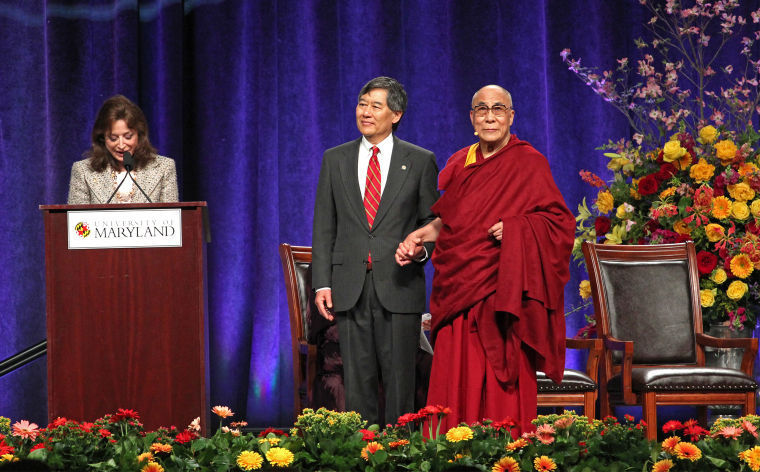

The Dalai Lama spoke to a crowd of about 15,000 students, faculty, and guests as part of the Sadat Lecture for Peace on May 7th, 2013
When the Dalai Lama left the Comcast Center yesterday morning, he took with him a piece of paper, a Maryland visor and a small bronze sculpture.
It wasn’t much, but it represented the thanks of about 15,000 students, faculty members and admirers for the Nobel Peace Prize winner’s wisdom at the annual Anwar Sadat Lecture for Peace yesterday morning.
University President Wallace Loh and Provost Mary Ann Rankin presented him with an honorary doctorate of humane letters, an official Maryland academic hood and a bronze sculpture called “Tangible,” a prize-winning, sandwich-like work created by Mark Earnhart for the 2012 Sadat Art for Peace competition.
The Dalai Lama, head monk of Tibetan Buddhism and 1989 Nobel Peace Prize winner, expressed the importance of inner peace, forgiveness and acceptance as the ultimate ways to achieve global peace during his about 90-minute lecture and question-and-answer session.
“Peace must come from inner peace. The source is compassion, forgiveness,” he said. “Once mutual respect is there, we can start mutual learning.”
Peace hinges on the ability to make deep connections and understand one another, both through faith and reason, he said.
Everyone plays a role in working toward world peace, the Dalai Lama said, but it’s the younger generation that has the greatest ability to carry on the work of creating a better world.
“You have the opportunity, the responsibility to create a better world, a happier world based on the oneness of humanity,” he said. “We can bridge the gaps between religions through mutual admiration and respect.”
The Dalai Lama is the latest from a long list of renowned peace leaders to speak for the Anwar Sadat Chair for Peace and Development lecture series. The series, launched in 1997, has hosted former South African President Nelson Mandela, former President Jimmy Carter and former U.S. Secretary of State Henry Kissinger, among several other world-famous peace advocates.
Born as Tenzin Gyatso on July 6, 1935, in northeastern Tibet, the 14th Dalai Lama was declared the reincarnation of the previous Dalai Lama, taking on the role as just a 2-year-old.
As a child, he began pursuing interfaith dialogue and is known for his understanding of international justice and peace, particularly in the contentious East Asian region of Tibet, Loh said. The Dalai Lama has been living in exile in India since 1959 as a consequence of his activism.
Despite his global role, the Dalai Lama is a “simple Buddhist monk,” Loh said, who nonetheless leaves deep impressions.
“His words turn the world on its head,” Loh added. “He says, ‘My religion is simple. There is no need for temples, no need for complicated philosophy. Our own heart is our temple, our philosophy is kindness and compassion.’”
Students began lining up outside Comcast as early as 5 a.m., clamoring to get a chance to hear what His Holiness had to say. Those who attended the lecture found the Dalai Lama’s words encouraging.
“I wanted to hear what he had to say about peace,” said Dino Profili, a freshman enrolled in letters and sciences. “He’s such an influential figure. It was interesting to hear how he addressed us as individual humans and that he treated us all equally.”
Sarah Ferrell, a sophomore hearing and speech sciences major, attended last year’s Sadat Lecture, entitled “America’s Stakes in a Changing Middle East,” which featured Zbigniew Brzezinski and Stephen Hadley, former U.S. national security advisers under former President Jimmy Carter and former President George W. Bush, respectively. But the 2012 lecture didn’t leave the same impact as the Dalai Lama’s words this year, she said.
“[Last year] it just went over my head,” Ferrell said. “I really enjoyed this one. It was great to hear how he emphasized that our generation has the opportunity to better the world.”