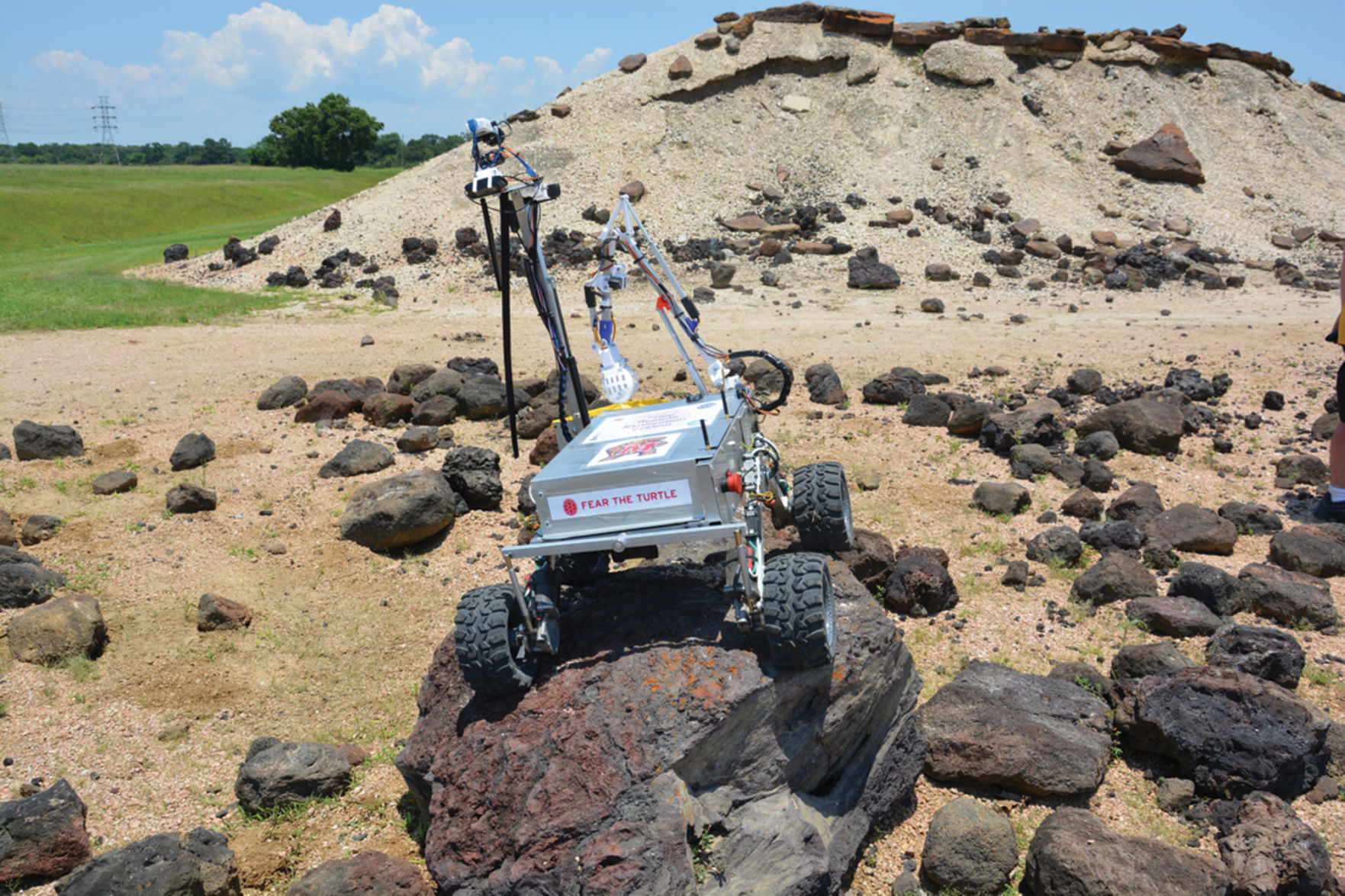

The rover, “Frigg,” designed by UMD teams climbs over a rock.
Two teams from this university’s engineering school won first place in NASA-sponsored competitions last month, working toward advancements in the aerospace field.
Participation in the competitions provides students with the opportunity to showcase their work to potential NASA employers and other experts within the industry, as NASA often hires straight out of the senior classes of David Akin, an aerospace engineering professor and the faculty adviser for the teams.
“Our program at Maryland has long been considered in the top 10,” Akin said. “The unique capabilities of the aerospace program [at Maryland] aren’t replicated elsewhere at other universities.”
The Robo-Ops Competition took place from June 2‑4 in Houston and challenged students from eight universities, including MIT, Virginia Tech, Georgia Tech and Drexel University, to design and perform a planetary rover prototype.
The RASC-AL Engineering Design Competition, the second of the two contests, occurred on June 14-17 in Cocoa Beach, Florida, and tasked students to plan a habitual settlement by 2054 within the NASA budget, Akin said.
This university’s Robo-Ops team created a rover called “Frigg” for the competition, which could collect terrain samples and could be tele-operated from remote controls by the university team.
“West Virginia [University] was our biggest competitor this year,” said Joshua Drubin, a senior computer engineering major and member of the 2015 Robo-Ops team. “They won last year, so they were the one to beat.”
Three students from the university team traveled to Houston to complete the on-site testing for the rovers, while two other participants maneuvered the rover from their respective campuses, Drubin said.
The judges awarded points for the type and amount of objects lifted by the rover during simulation. Several cameras installed into the rover allowed its controllers to manipulate the system from this university’s headquarters, Drubin said, and the team won first place.
“[The rovers] have to be able to traverse difficult terrains that include things like craters, sand and rocks and pick up geological samples,” Akin said. “They have to be both easily manipulated and mobile.”
In addition, for the design competition, a different group of students enrolled in Akin’s senior capstone class devoted the whole year to the project, preparing since the first lecture, he said.
“This is a project that has befuddled NASA for years,” Akin said. “It’s interesting that they would come to the students for fresh ideas.”
Part of the coursework entails a 500-page design report to be completed by the whole class, said Samantha Walters, an aerospace engineering major who co-presented the work at the competition. That report was subsequently trimmed down to 15 pages to be presented at the contest, she said.
“There were 33 people in our class, which was a lot to keep track of,” Walters said. “Especially since we were all at the same level — there were no leaders.”
Akin said students from this university have won the aerospace design competition several times in the past, so this win was no surprise.
“It’s very rigorous work,” Akin said. “We try to make [students] aware of the expectations early on, which might be why we do quite well.”


