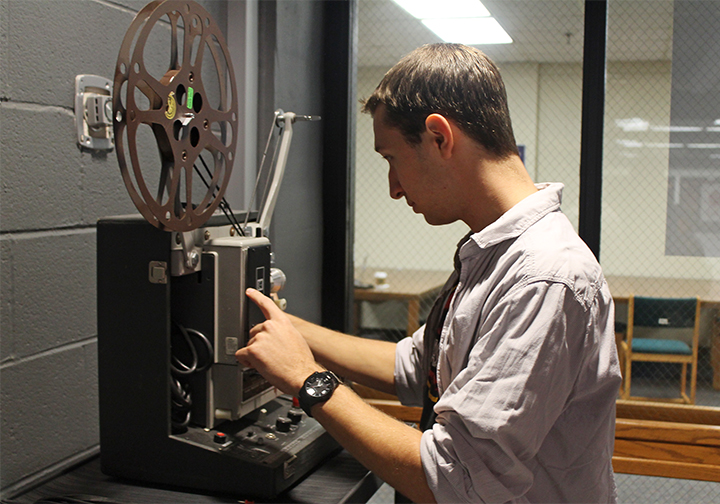

Zack Burkett, a junior and one of about 45 students in the new film studies major, inspects an antiquated projector Tuesday. Burkett, a passionate member of the Maryland Filmmakers Club, hopes to attend graduate school at the University of Southern California to study production and eventually make his own movies.
Now that the university’s new film studies major is in full swing, cinema fans can spend their years on the campus studying what they love.
About 45 students are enrolled in the major, which the university approved in spring 2012. The program aims to teach students how to critically analyze and interpret films throughout history, said film studies adviser Marianne Conroy.
Although several students said they are happy with the courses offered, some said that without a film production component to the major, those who are passionate about a future in filmmaking must pick up the slack themselves.
“If you want a career in film, if you just do the major, I don’t think it’s enough at this point,” said Jonathan Ryan, a sophomore film studies major. “It prepares you in a way to understand how to make film, but it doesn’t show you the production stuff.”
Ryan is also involved with the Maryland Filmmakers Club, which complements film studies classes by giving its members experience with the production process. The purpose of the club is to teach members about each step involved in making a film, from writing the script to making the final edits, said Gaurav Khetan, the club’s senior adviser. Members split into small groups to make short films, which are showcased at the Hoff Theater at the end of each semester.
“We work closely with the [film studies] department and help promote the major, and they help promote us,” said Khetan, a senior community health major.
Even without a production aspect, the major has a lot to offer, said Zack Burkett, a junior film studies major who is also a member the filmmaking club. Burkett hopes to attend graduate school at the University of Southern California to study production and eventually make his own movies.
“[The film studies major] gives you the right eyes and mindset to make good film,” he said.
“Watching, analyzing and learning about all these classic films and directors teaches you how to think like a filmmaker.”
Although Los Angeles and New York City are known as the best places to be a filmmaker, Washington has its own unique set of opportunities for aspiring producers, film studies professor Oliver Gaycken said. The Washington area boasts the Library of Congress, which has one of the biggest film archives in the world, as well as companies such as the Discovery Channel and National Geographic that produce world-renowned documentaries, he said.
“The quality of the program and resources of the area are rare,” Gaycken said. “D.C. is an extraordinary town for archives and museums.”
It’s also a great place for freelancers, particularly those who specialize in promotional videos for politicians and other public figures, Ryan said. Popular political shows filmed in Washington, such as The West Wing, create opportunities for actors, videographers, directors and other people in the film business, Khetan added.
Whatever city they end up in, though, the future likely won’t be easy for students looking for careers in film.
“It’s really hard to make it in the film industry,” said Burkett, who’s heard stories of aspiring filmmakers living in their cars while they struggle to get by. “Only a few people make it.”
But ever since his father took him to see Star Wars: Episode I — The Phantom Menace in theaters when he was five years old, Burkett knew he wanted a future in film. Because he stutters, it can be difficult to communicate his thoughts clearly, he said, but storytelling through film is a way for him to express himself.
“From that moment on, I became enthralled in the world of film,” he said. “Through storytelling, I can convey all these ideas I have.”