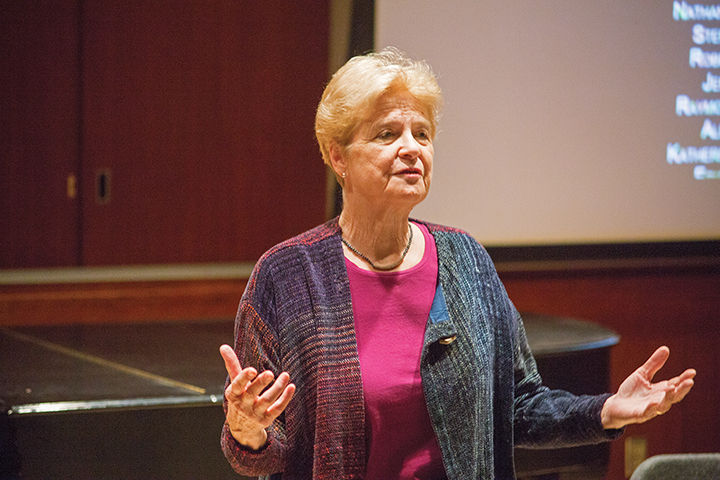

Dr. Martha Davis, Director and Producer of the documentary Doctors of The Darkside, speaks after a screening of her documentary in the Leah Smith Recital hall on Wednesday April 15, 2015.
About 20 students and faculty gathered last night at the Clarice Smith Performing Arts Center to watch Doctors of the Dark Side, a documentary about the role that some physicians and psychologists played in interrogating prisoners after 9/11.
Martha Davis, the film’s director, attended the event and held a discussion with the audience afterward. A psychologist herself, Davis said she was upset that others in her profession participated in these practices.
“I had to make this documentary because psychologists were one of the groups that were implicated, and as a member of the American Psychological association, I knew many people who were upset by this,” she said.
Many in the documentary alleged the medical professionals involved violated the ethical code of “doing no harm” to patients by cooperating with torture practices.
Davis teamed up with Oscar awarding-winning filmmaker Mark Jonathan Harris, along with CIA analysts, human rights activists and lawyers to complete the film in four years.
The documentary showed video depictions of torture techniques that detainees underwent, including sleep deprivation, waterboarding, prolonged stress positions, confinement in small spaces and force-feeding.
While the videos were shot using actors in a warehouse in New York, the details of torture techniques, down to the exact dimensions of the waterboards, were gathered from declassified government documents.
“Violence doesn’t help anything. It just increases the whole fumes of war,” said Sinclair Ogaga Emoghene, a dance graduate student who attended the event.
The documentary also recounted the story of Petty Officer 1st Class Daniel King, a Navy cryptanalyst. King, who served in the Navy for 20 years, was accused of spying in 1999 after a routine polygraph test described his results as “inconclusive.”
He was held in jail for 520 days and said the interrogation process made him suicidal.
Davis said she hopes students learned this is a domestic issue as well as a foreign one.
“If students know there are 80,000 Americans in really terrible isolation that makes some crazy and suicidal … and that if that really upsets them, then they are encouraged to join a very big movement,” she said.
Jim Riker, director of Beyond the Classroom, a university-run leadership program, said he planned this documentary screening in hopes that students learn they can enact change.
“I hope they learned that citizens have a voice in the decisions that affect them, and they can play a key role in holding their governments accountable,” Riker said.


