
Amber Jackson
Amber Jackson doesn’t remember her first Little League team.
As a kid, she had no reason to keep track of mascots or team colors. Softball was just something to do — a way to expend excess energy beyond the Fontana, Calif., concrete.
When she enrolled in high school, Jackson figured she would quit, focus on school and earn an academic scholarship to college. Softball was no more than an early chapter in the life story she had drafted for herself.
She will never know, however, the ending her story would have yielded had she quit softball.
There were many moments when Jackson’s career could have suddenly expired — in ninth grade when she grew tired of playing with the same teammates season after season, or her junior year of college when she injured her back in a car accident and shattered her resolve to return to the field — but she remained in the sport.
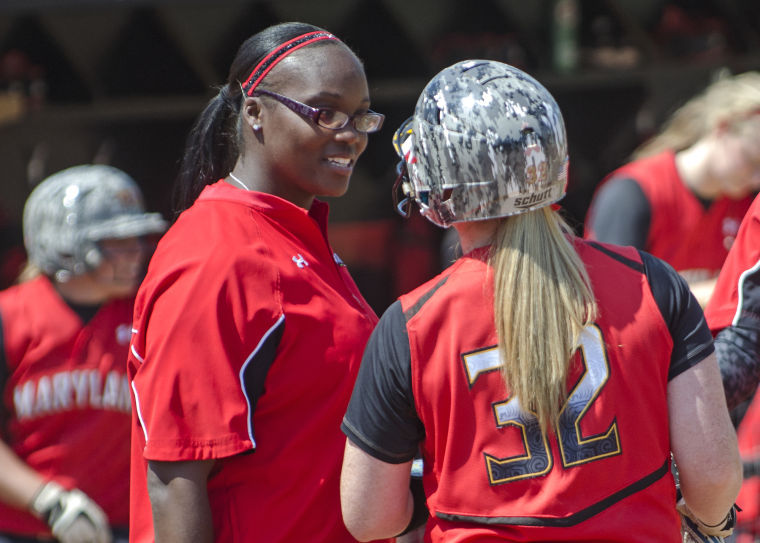
Now, wrapping up her second year as assistant coach of the Terrapins softball team, Jackson no longer thinks about the day she will step away from the sport. Instead, she envisions the next phase, despite her wavering relationship with the game in the past.
What does softball mean to Jackson after being involved in the sport for more than 15 years? After it took her 2,500 miles from home?
As one of the best hitters in NCAA Division I history, Jackson owes much of her reputation to the sport. But to properly answer those questions, Sarde Stewart responded as she believed her older sister would.
“At the end of the day, it’s like, ‘That is my passion. That is what I’m going to go back to no matter how much I try to fight it,’” Stewart said.
UNTAPPED POTENTIAL
Jackson doesn’t think this generation, the one she helps coach, can understand the way she grew up.
“Children these days, they don’t just go out and play,” Jackson said in late March, sitting in her office in a black Terps softball sweatshirt. “We played outside until the streetlights came on.”
Jackson remembers spending most days and evenings playing tag or pretending to be a Power Ranger in her Fontana neighborhood. She played pickup basketball. There was little organization, and turning the games she simply played for fun into a career never entered the elementary schooler’s mind.
But Jackson also remembers tougher moments of her childhood, ones that set her early days farther apart from others.
Jackson’s father passed away when she was 2 years old, and her mother was in and out of jail during Jackson’s entire childhood. Born in Los Angeles, Jackson lived with her grandparents, Henry and Annie Fulcher. But not knowing her parents left some emptiness inside.
“Seeing other people have that and not having it … it made it very difficult,” Jackson said. “So I was very quiet.”
She also remembers her fulfilling athletic experiences as a child, like the times she played stickball with next-door neighbor Tatiana George — who went on to play for Florida State in the 2002 and 2004 Women’s College World Series.
Soon, Jackson started to see George leave to play softball, and it sparked an interest. As her curiosity grew, the sixth-grader asked her grandmother to sign her up for the Fontana Little League. The family saved money, and Jackson began softball the next year.
At first, organized softball was very nerve-wracking for the quiet seventh-grader. She had never been a part of a team before, and having people depend on her made her feel uncomfortable.
Jackson recalls struggling at the plate, but she made up for it with her speed. Besides, she didn’t expect herself to crank out home runs and smack line drives at this stage.
“It was fun,” Jackson said. “Different than just playing outside.”
That was all it was to her, and she didn’t seem interested in having it become anything more. But those around Jackson realized she had scratched only the surface of her potential.
‘THIS REALLY GOOD PLAYER, YOU KNOW?’
Dick Bruich already had an extensive resume as football coach of state champion Fontana High School, but he also had a much less notable gig on the side: softball coach.
Bruich heard from gym teacher Floyd Youmans there was a freshman with a bat worthy of the varsity team. And at tryouts, one swing from the gangly Jackson left the legendary coach enthralled.
Bruich wanted to do anything he could to get her to continue her career. Jackson was tired of playing with the same teammates year after year, and she didn’t want to be stuck on a freshman team.
“She had this awesome swing and was just this really good player, you know?” Bruich said. “First game, we stuck her out in right field. We wanted her to bat in the lineup.”
She made varsity and started from day one. Varsity softball rejuvenated Jackson’s interest in the sport. She loved to hit, she said, and enjoyed the low-pressure environment. Jackson also to challenge herself. She wanted to be Fontana’s starting shortstop. Five games later, she was.
“Once she was there, she was into it,” Bruich said. “When she commits to something, she’s into it 100 percent.”
RECRUITMENT
Following Jackson’s freshman year, Henry J. Kaiser High School opened closer to home, so she transferred.
Then, Jackson received offers to play travel softball. She hardly wanted take that next step, though, especially after attending an open tryout.
“One girl is getting yelled at for yawning on the field and not hustling,” Jackson said. “Another girl has passed out because the workout was so long, and an ambulance came.”
The intense environment was unattractive to a girl who had no intention of playing past high school. Travel softball was also too expensive, but a mother of a former teammate at Fontana offered Jackson and Stewart, who played with her sister on Kaiser’s varsity team, the opportunity to play for free.
While at Kaiser, Jackson reluctantly — yet smoothly — transitioned to travel softball.
The competition reminded her of her former neighbor, George. It pushed her in ways she wasn’t pushed in high school. She was forced to move back to right field. Jackson was still a raw talent, and she still struggled with the awkwardness of adapting to her wiry frame.
“The game became a lot quicker, so I would try to do things quicker,” she said. “But my feet would get there before my glove.”
Her speed and body type served her well in the outfield, and many college coaches recruited her there. Still, Jackson thought playing outfield was too easy. She wanted to be a shortstop because it was a challenge, but no interested schools needed her to play there.
Jackson focused on Bethune-Cookman in Daytona Beach, Fla. The coaches were displaying heavy interest in some of her teammates, so she approached them, confused and somewhat annoyed.
“So you’re not going to recruit me?” Jackson said. “Why aren’t you going to talk to me? I know I’m better than her.”
As it turned out, Bethune-Cookman thought Jackson wasn’t interested. She had never responded to the Wildcats’ letters — she didn’t know she had to. Jackson eventually connected with then-coach Laura Watten, who had good news for the prospect.
“We knew that she would be able to be versatile in any position,” Watten said. “We just so happened to really need a strong shortstop.”
BIG NUMBERS
Bethune-Cookman ended up being the perfect fit for Jackson.
In her three years with the Wildcats, she batted .465 with 34 home runs and 175 RBIs. She also stole 74 bases and got caught only seven times.
“She definitely holds herself to a higher measuring stick,” former Bethune-Cookman teammate Lauren McCoy said. “As anybody with her ability and talent should.”
Those numbers didn’t matter to Jackson, however, if she couldn’t perform in critical moments. After Texas swept the Wildcats in the 2005 NCAA Super Regional, she was particularly hard on herself.
Jackson was no match for Longhorns ace and 2004 and 2008 U.S. Olympian Cat Osterman in Game 1, and Jackson struck out four times in a 1-0 defeat.
“I never strike out four times in one game,” she said. “[I was] doubting myself and my ability.”
It was one of her lowest moments of her career.
After the season, Jackson injured her back in a car accident. Her desire to play, let alone return to the postseason, took a huge hit.
Jackson was in constant pain when she swung the bat, and she didn’t know if she could fight through it. But Watten motivated her to continue playing, so she went through extensive physical therapy to prepare herself for the next season.
“I think [Watten] has been a bigger influence than Amber would let on,” Bruich said. “Amber grew so much around her.”
But when Watten left to take the coaching job in College Park after the 2005 season, players gradually lost their drive, and the team environment quickly dissipated. With that, it was time for Jackson to move on.
The Terps offered her and Stewart scholarships, and the sisters were reunited with Watten in 2007.
Jackson received her master’s of education at this university while breaking single-season records in batting average (.408), home runs (24), RBIs (56) and walks (55) in the process.
Though she was set on ending her playing career again at the end of college, she was constantly pushed by those around her to play at the next level: National Pro Fastpitch.
‘NEXT STEP’
Jackson enjoyed two successful years with the Washington Glory and starred on the 2007 NPF championship team.
But after the 2008 season, the Glory folded, and the players’ contracts were picked up by the USSSA Pride in central Florida.
After being surrounded by friends in the Washington area, she failed to rebuild the network that existed before in Florida.
Her body ached, and Jackson decided to “take the next step” in her life. She gave softball lessons while working part-time as a teacher’s assistant at Steuart W. Weller Elementary School in Ashburn, Va.
It wasn’t long before Jackson was drawn into coaching. A local coach recommended her to Loudoun County High School in Leesburg, Va., which was looking for a coach. Soon after, she got a call from the school.
“Well, why not?” Jackson said. “Just give it a try.”
She was young and had never coached before, but Loudoun County hired Jackson to lead its softball program. Now she had new responsibilities: hiring assistants, managing a junior varsity program and dealing with parents.
Despite the numerous tasks, Jackson said she never felt overwhelmed. After all, she was responsible for her players for only several hours before they returned home.
“I knew I liked high school because of that aspect,” Jackson said. “It wasn’t going to be full-time. It wasn’t going to be my life.”
Later on, though, that view of coaching would change.
A CHANGE OF HEART
During her time at Loudoun County, Jackson went on a sports mission trip to East Asia.
Athletes there had no emotional support from their coaches, and she was taken aback.
“Their self-esteem, their self-confidence and who they were as an athlete was diminished because of their experience,” Jackson said. “That broke my heart.”
In those athletes’ pain, she saw where she could make a difference. Jackson had known only supportive coaches like Bruich and Watten in her career and couldn’t fathom a career without them.
“People would ask me why [I went] to Bethune-Cookman, to play softball; I didn’t go for academic reasons,” she said. “When [Coach Watten] quit, that was just ripped away from me. That was one of the hardest times of my life.”
As someone who had been through many hardships in her childhood, she wanted to make sure other athletes with similar lives didn’t endure their experiences alone.
When Jackson returned to College Park as a Terps assistant coach in summer 2011, she knew what to expect in her new position.
“It’s not just coaching the game,” Jackson said. “That’s minimal. You’re coaching them on life.”
A CERTAIN FUTURE
Jackson’s spent most of her life living in uncertainty.
Given the environment she was raised in, she sometimes thinks she shouldn’t have made it this far.
But those who have gotten close to Jackson say she has had a greater impact on them than they have been able to have on her.
“She’s taught me a whole lot about myself,” Watten said. “She absolutely will tell me how she feels. … She cares about my growth as well.”
Jackson is no longer just waiting for her career to end. It’s turned into something far more important than it was all those years ago, out on the street in Fontana’s dusk when she had a completely different life planned.
Her next chapter hasn’t been written yet, but now she’s sure she knows what it will say.
“I think I’m going to be at that point where I do want to be a head coach one day,” Jackson said. “[It’s] a lifestyle, it’s not a job … it’s who I am; it’s what I do.”
sportsdbk@gmail.com