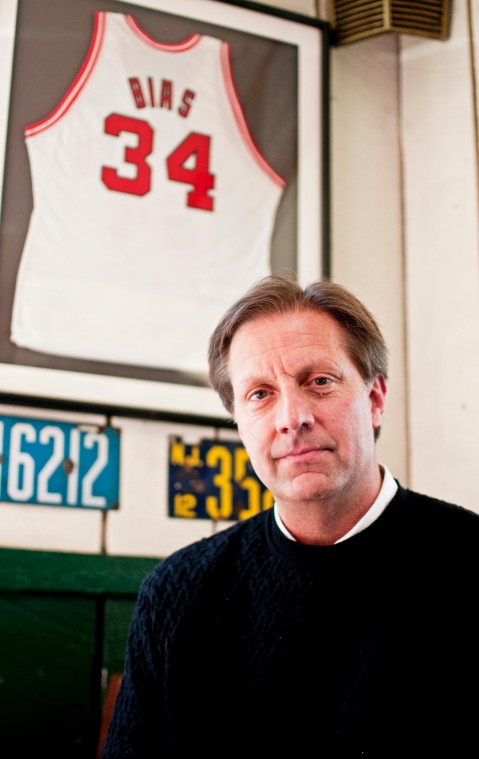

Dave Ungrady, a university alumnus, is set to release Born Ready
Dave Ungrady isn’t concerned with rehashing history.
He knows the story of Len Bias’ death has been told before: The cocaine overdose in Washington Hall. The grand jury indictment of teammate Brian Tribble. The dismissal of coach Lefty Driesell.
Books have been written about it. Documentaries have examined it.
So when Ungrady decided to start working on a Bias book after being laid off from Universal Sports in January 2010, he was wary of revisiting a crime scene. The Bias story needed a fresh angle.
“I had seen the 30 for 30 documentary [on Bias’ death],” Ungrady said Thursday, eating lunch next to a framed Bias jersey at R.J. Bentley’s. “And I saw there was no book about it, about his life, per se. A couple books had come out about his death in the early ’90s, but nothing since then and nothing that really got into his life. So I looked into it, and I thought, Let’s give it a shot.”
After more than 23 months of long nights and tireless interviews, he’s finally got one. Born Ready: The Mixed Legacy of Len Bias, Ungrady’s self-published, 187-page examination of Bias’ life and legacy, will be released later this week. Ungrady will hold a book signing in Comcast Center on Wednesday before the men’s basketball team’s game against Florida International.
A 1981 alumnus who played soccer and ran track for the Terps, Ungrady said he drew upon some of his connections with the athletics department to write Born Ready. When he decided to write the book, the first person he called to interview was Dick Dull, the Terps’ athletic director at the time of Bias’ death. Dull, an assistant coach for the track team during Ungrady’s tenure at this university, gave him a starting point.
Ungrady’s ties to the university often proved helpful, but the project was far from easy. Ungrady called it “by far” the most difficult undertaking of his career, noting his struggles to get in contact with Bias’ family and former teammates.
Even 25 years after Bias’ tragic death, many people were reticent to revisit memories of the All-America forward.
“The hardest part about this book was getting people to talk about him,” said Ungrady, who delayed the book after initially planning to release it in June to honor the 25th anniversary of Bias’ death. “People are still very affected by him. They’re still very reluctant to talk about things because of the way he died and the impact of his death.”
Yet that didn’t keep Ungrady from tracking down new information about Bias.
Born Ready humanizes the man behind No. 34. It portrays a young basketball player from Landover who at times struggled to adjust to his newfound fame.
And while it touches upon many of Bias’ highlights — a stellar high school career at nearby Northwestern High, wins over ACC rivals, the 1986 Draft — the book also reveals aspects of Bias’ life that aren’t nearly as shimmering.
Born Ready details Bias’ history with drug use, a topic Ungrady said the media has been apprehensive to investigate fully. It notes several of Bias’ experiences with cocaine prior to the night of his death, and includes allegations from former N.C. State star Chris Washburn that Bias introduced him to cocaine on a summer barnstorming tour.
Washburn, the No. 3 pick in the 1986 NBA draft, became a cocaine addict and lasted only two years in the NBA due to his drug use.
Ungrady also spoke with a 25-year-old man named Michael Leonard Bias, who hasn’t spent a full year out of jail in more than a decade. According to a birth certificate provided by the man’s mother, Tina Maynard, he is Bias’ son.
Although Ungrady acknowledged that such revelations are sure to garner attention, he said they’re just part of the Bias story — a story that’s been ignored for far too long.
“Lenny was a god at Maryland,” Scott Van Pelt, a current ESPN broadcaster and university sophomore at the time of Bias’ death, says in the book. “An absolute god. He was that good and he was larger than life in every sense of the word. That body, that booming voice, he was from outer space.”
Yet the university has done little to honor Bias, a reality Ungrady called “awful.”
“There’s no monument for Len Bias,” said Ungrady, who wrote a June essay for The Washington Post supporting Bias’ bid to join the University of Maryland Athletic Hall of Fame. “There’s no stadium in his name. There’s not even a street named after Len. People wanted it to go away, and to an extent, they still do. There’s so much reluctance to relive his story.”
Born Ready gives people that chance — an opportunity Ungrady hopes this university’s community seizes.
“I just want people to understand him better,” he said.
letourneau@umdbk.com