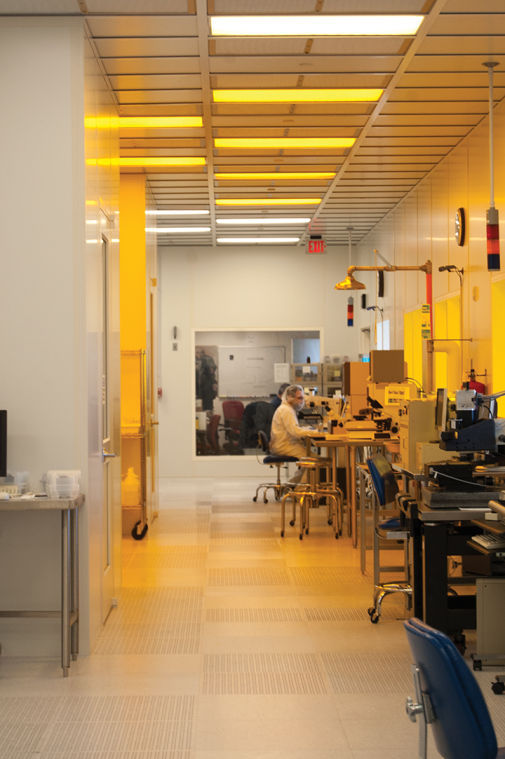
A high-performance air filtration system whirred softly throughout the orange-tinted room. A scientist peered out from plastic goggles at a reaction spurred inside a machine that cost more than $100,000. Another researcher took notes on a sheet of slippery, latex-saturated paper.
At FabLab, a nanotechnology center tucked away in its own wing on the second floor of the Jeong H. Kim Engineering Building, cleanliness is next to godliness — and perhaps only a nanometer or so away.
“If you’re working with this kind of stuff, a particle of dust is like Mount Everest,” said Jim O’Connor, FabLab director.
Because work on nanotechnology is so precise, no one can enter the laboratory without donning a full bodysuit made of polyethylene. Shoes must be covered after a machine brushes off dust. Ceiling lights tinted orange cast a hue on the lab that avoids not affecting any chemical processes by way of ultraviolet radiation from the sun.
The air in parts of the 10,000 square-foot laboratory is filtered to be 1,000 times cleaner than the air in the rest of the engineering building, and only particles less than a half-micron in size remain in the air. By comparison, a speck of dust is about 10 microns.
“‘Nano’ means one-billionth, so we’re working with things that are about one-billionth of a meter in size,” O’Connor said. “To put that another way, if you piled 50,000 nanometers in a row, it’d be about equal to the length of the diameter of a hair on your head.”
In 2006, then-Gov. Robert Ehrlich allotted a $3.65 million grant to FabLab, allowing the center to purchase the major equipment it needed. Now, though the lab charges scientists to conduct research there, O’Connor said it struggles to bring in enough money to keep the tools at a state-of-the-art level.
“We can’t make money,” he said. “We have to just break even.”
Any revenue goes toward updating and purchasing equipment, said John Abrahams, one of FabLab’s five-member staff, which includes O’Connor.
To use any of the center’s tools, such as a wet bench for liquid-phase chemical work or a metal deposition system for such work as covering a product with an aluminum film to prevent outside environmental effects, the FabLab charges outside commercial interests $225 per hour but offers a subsidized rate of $77 per hour for university scientists.
Since 2007, about 2,000 people have made use of the lab, completing about 70,000 process steps. Researchers have come from as far as the University of Vermont, O’Connor said.
Some researchers, such as Catherine Liu of bioengineering company LOC Micro, chose FabLab over comparable nanocenters. She said the company decided to develop its biosensor, which can be used to detect infectious diseases and viruses, at this university’s nanolaboratory, instead of those atthe Georgia Institute of Technology and Pennsylvania State University because FabLab’s “price and quality were the best deal.”
FabLab is limited in size, and thus limited in other capabilities, but until LOC Micro requires work done on a larger scale, Liu said the company plans to remain working there.
“When we’re not going to collaborate with FabLab is when we go to mass production,” she said.

A microchip on a silicon wafer is just one creation of the FabLab, a nanotechnology center in the Jeong H. Kim Engineering Building. The facility attracts scientists from across the country.
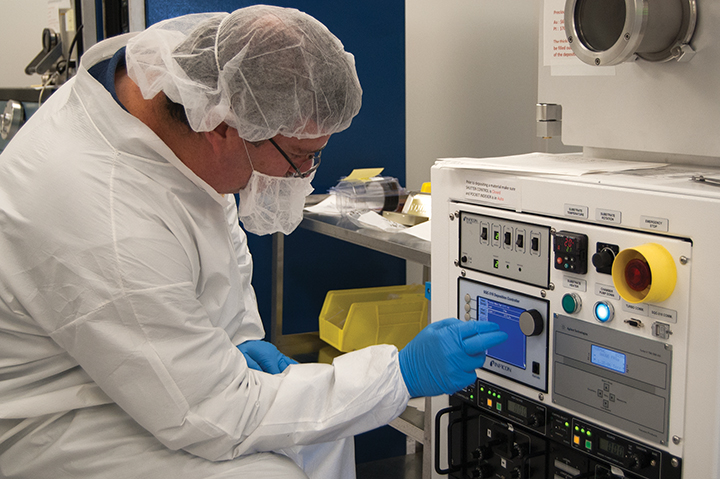
A scientist changes the settings on a lithograph machine inside one of the FabLab’s clean rooms.
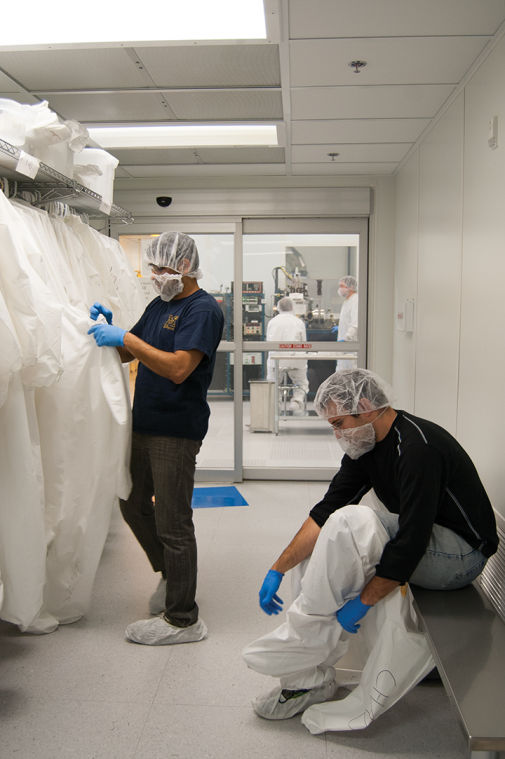
In order to work with nanochips in the FabLab, students and faculty must wear sterile suits so as not to contaminate the wafers.
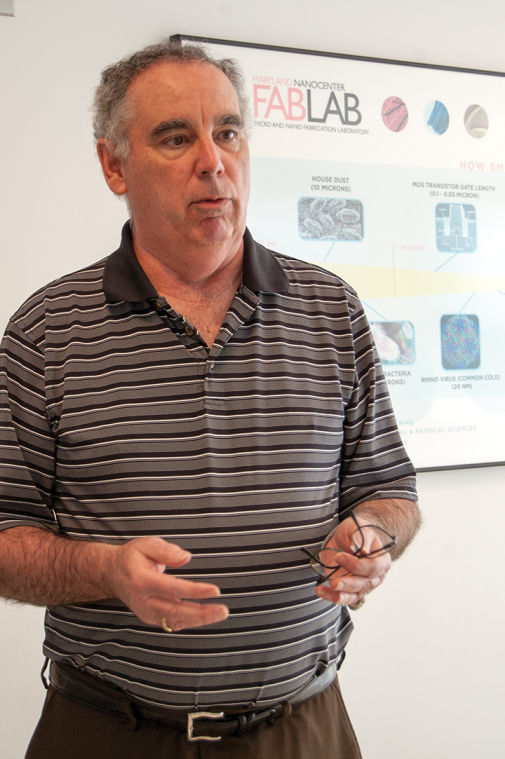
Dr. Jim O’ Connor directs UMD’s Micro and Nanofabrication Lab, also known as the FabLab.