Ellen Levine and Yao Yao sit outside the Stamp Art Gallery and talk. They discuss Yao’s computer science research, upcoming finals — and the recent release of the Avengers movie.
“I don’t understand all the languages because there’s not subheads, but I think I missed a lot of details,” said Yao, 26, a visiting scholar from the Beijing Institute of Technology. “Even if you don’t know the background, there is a good guy and a bad guy, the pro…”
“Oh, the protagonist and the antagonist,” said Levine, a sophomore English major.
“So who is who?” Yao asked.
“If it is good versus evil, it is almost always the protagonist versus antagonist,” Levine said. “Most stories go like that.”
This is the last of Levine and Yao’s weekly meetings through this university’s English for Speakers of Other Languages Conversation Program, which is set up to help international students and scholars better their English and expose those involved to other cultures.
Sharon Kirkland-Gordon, Counseling Center director, announced May 4 the program would be cut in a letter to ESOL volunteers and participants. During the 2013-14 academic year, 482 students were involved in the program, according to a report from the Counseling Center.
The program’s termination is due to a 2 percent cut, totaling about $54,000, to the Counseling Center’s budget for next year, Kirkland-Gordon said. It takes about $20,000 to run the ESOL program, between the cost of the graduate assistant who heads the program and miscellaneous costs, such as events and teaching materials, she added.
The University System of Maryland faced $40.3 million in cuts this year, resulting in a $15.6 million cut for the university.
Kirkland-Gordon said in this fiscally difficult time, the center needed to look at its core mission and priorities, which are mental health, learning support and academic support. Although the ESOL program is valued, she said, she needed to make a “tough decision.”
When balancing cost and the center’s priorities, Kirkland-Gordon said they also cut the Peer Assisted Learning program, as the center felt other programs the center still offered could accommodate those in the PAL program.
Tiffany Pao, the current ESOL coordinator, said many of those involved in the program are willing to pay to participate if it meant the program could still operate. As a former participant from Taiwan, Pao said she knows how valuable it is to have this option available for international students.
“Any little life things, like going to a supermarket, is a very difficult thing. We may meet troubles because we don’t understand the menu,” Pao said. “[The ESOL program] is really good for me to adjust my life in the States. You will know there are people who can help you with your life.”
Haiku-Ping Wei, 33, a mechanical engineering doctoral student, said he participated in the ESOL program for four semesters. This semester, his group consists of people from India, Taiwan, Korea, Japan and America, which not only helps the international students learn about American culture but also enhanced the participants’ worldviews, he said.
“Opinions and experiences from every different countries, it’s so amazing,” Wei said. “If we don’t have that kind of program, I think we don’t have that kind of opportunity.”

ESOL
Although Pepper Phillips, the Learning Assistance Service acting assistant director, said she was “saddened” to have to make this cut for budgetary reasons, she said she thinks the program could still operate in a new form, either as a student-run club or if another program absolves it.
Pao said the program would not operate as well if it were run by students. Currently, the program has strict rules and regulations for the weekly meetings. For example, if participants do not show up to scheduled meetings three times over the course of a semester, they could lose opportunities in the program.
A petition to save the ESOL program gained more than 550 signatures, Adam Lax, the previous program coordinator and a graduate student studying international education policy, wrote in an email.
“It serves a fair amount of people from the community, so for international folks, whether they are students or town people, it plays a very important role for them,” university President Wallace Loh said. “Maybe they can band together and get it restarted in some other way.”
Without the program, Wei said new international students, visiting scholars and the American volunteers will lose the “chance to explore and experience other cultures,” and those who do not speak English well could feel isolated on the campus.
“A lot of international students — they will be lost, left out because they can not make friends or they can not even just practice their English that much,” Pao said. “If they have partners and groups to help them or practice or be friends with them, they will feel like they are more involved in the American culture.”
CORRECTION: Due to an editing error, the subhead incorrectly stated that terminating the ESOL program saves about $54,000 in the Counseling Center’s budget next year. Terminating the program saves about $20,000 for the center.
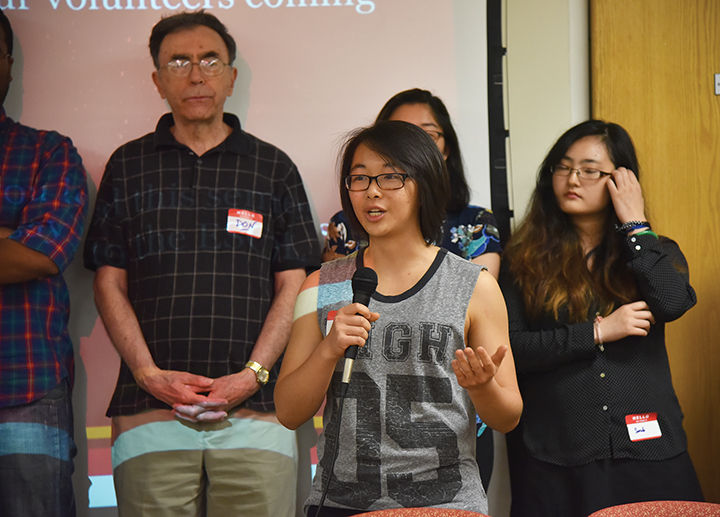
Joy Wang, a freshmen civil and environmental engineering major and language partner, speaks at an end of semester ESOL event where students and language partners shared their favorite memories from the program on May 8, 2015 in St. Mary’s Hall.
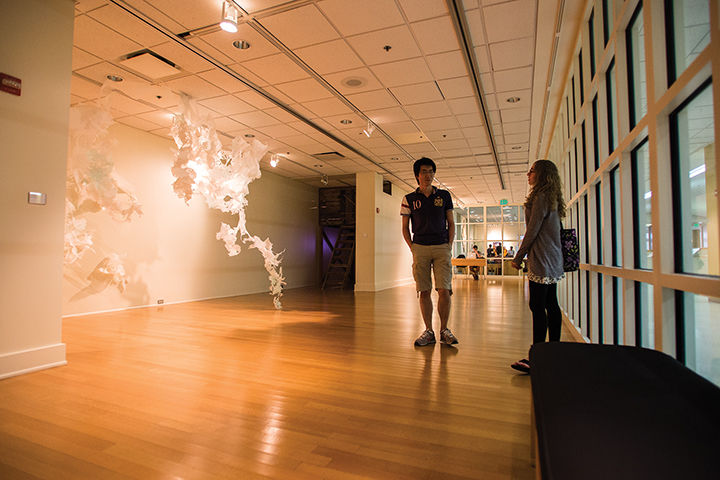
Ellen Levine, a sophomore English major and Yao Yao, 26, a visiting scholar from the Beijing Institute of Technology, walk around the Stamp Art Gallery during the last of their weekly meetings through this university’s English for Speakers of Other Languages Conversation Program.


